We were one thousand miles from home. I had spent every penny of the money my mother-in-law had loaned me to apply to medical school. There was a new credit card in my wallet which was already maxed out. Among the lessons I had learned in recent weeks: it takes a lot of money to fill a 50-gallon tank on a moving van.
Savings? We didn’t have any. No financial reserves, no rainy day fund, no hidden cash stash. Our only assets were a hand-me-down minivan from my uncle and a laptop computer that was already falling off the upgrade curve.
But we were going places! Quite literally, in fact. My eyes were on the prize, and I honestly felt like I had already earned it. An honorable, prosperous, and stable career in medicine was in my future, as long as I kept up with my medical school coursework. I was like the young army recruit stepping off the Greyhound bus to report for duty; it felt like I had already come a long way, but I had no idea how far I had left to go.
We were happy, partly because we didn’t comprehend how precarious our position was, but also because our position was a means to an end. So deep was our trust in the future that my wife Marisa and I were already building our family. A few weeks after the cross-country move we celebrated our third wedding anniversary by having an ordinary dinner at home with our two kids. Family was our real purpose, and this whole career in medicine thing just seemed like a good way to support one.
Our evening routine was based on the old military adage: divide and conquer. Our baby would only fall asleep if she were held, so one of us stayed at the apartment with our two year old while the other one walked around the apartment complex with the baby in a sling.
That apartment was one of my first experiences with internet shopping. After I was accepted to medical school we had to find a place to live in a city one thousand miles away which I had only visited once briefly for my interview at the school. A house hunting trip was out of the question, unless I could somehow scrounge up a few hundred dollars for plane tickets and a hotel room. But that seemed like a waste of resources when we were going to move there anyway just a few weeks later. So I got online and found the website of a large property management group that owned a dozen or so apartment complexes in the city. We settled on one of them which claimed to have “Exquisite Townhomes” located in a quiet suburb. When we called them on the phone they promised to have a unit ready for our move-in date, and when we arrived at the main office with our moving van a few weeks later we signed the lease contract before we had even walked through the unit. I don’t recommend doing that yourself, but thankfully it worked out for us. The apartment had freshly white-washed walls and brand new very cheap carpet. After a few weeks it didn’t smell much like tobacco smoke anymore.
“More like Adequate Townhomes,” I said to Marisa.
There was much to see on those evening walks. There were nearly three hundred of those exquisite things packed into about fifteen acres, with sidewalks around and through the whole complex. In the center was a large gazebo, and at the front along the main road there were large ponds with fountains running to keep the water from going stagnant. There was also a very small swimming pool near the office.
But the most interesting and useful thing to do was visit the dumpsters. There were maybe six or seven of these scattered around the place, and we quickly noticed after moving in that people tended to leave perfectly good things at the garbage. It was a quirk of the local culture to leave unwanted things “up for grabs” at the dumpsters, or at the curb in front of your house, and there was no shame in scrounging such items to use in your household. Take something today — leave something tomorrow.
We did a lot more scrounging than donating.
~~~
“We need a futon,” Marisa said. “My mother is coming to visit, and she needs somewhere to sleep. We don’t even have a couch.”
“What’s a futon?” I asked.
“One of those couch thingies that folds out into a bed,” she said.
“Like a hide-a-bed?”
“No, it has a mattress, and the back of it folds flat to turn it into a bed.”
I still didn’t know what she was talking about. “Well, how much do they cost?” I asked.
“I don’t know.”
We looked at each other for a moment. Finally I said, “We probably can’t afford anything like that.”
But Marisa was undeterred. A week or so later she found a slightly bent metal futon frame by the dumpster, and the two of us dragged it home.
“See?” she said. “This is a sign. We really need a futon.”
Again we looked at each other, and I saw the faith beaming from her beautiful brown eyes. Maybe this was the hand of Providence, getting us halfway to our goal. I wanted to believe.
“Alright,” I said. “I’ll look for a futon mattress on Saturday.”
~~~
That was easier said than done in 2004, when MapQuest was still the de facto standard for online maps, GPS navigation devices were millionaire toys, and smartphones had yet to be invented. My only tools were the yellow pages and a paper map, which I used to plot my own course through unfamiliar city streets. That is a skill which is probably already lost in the rising generation. It took me a few hours to visit half a dozen or so secondhand stores. Barefoot in the snow, uphill both ways, and all of that.
I found nothing but old couches at the thrift stores.
My next stop was a mattress store, where the sales clerk showed me what he had in stock. Futons ranged in price from about $150 to nearly $1000, and I could easily observe that you get what you pay for in this product category. The affordable options were only arguably adequate to the task of being slept on. I could imagine my mother-in-law trying to sleep on some cheap mattress, feeling the bars of the metal frame all night and complaining to no end. It made me shudder to think of it.
At the top end of the range was a nice futon with a wooden frame, with a thick mattress. It looked like a nice place to sleep. I searched for the price tag, and my heart sank when I saw that it cost $950.
“Thanks for showing me these,” I said to the sales clerk. “I’ll think it over, and I might be back later.”
I walked outside, still reeling from the sticker shock, and climbed into the old Ford Windstar. Here I was, a new husband and father, tasked with providing for my family but lacking the means to do so. “There’s no way I’m spending that much money on a futon,” I said to myself. “I don’t even have that much! And there’s no way I’m wasting any money on a piece of garbage that I’ll never hear the end of complaints about.”
In front of that mattress store, sitting in the driver’s seat of our minivan, I started to pray. “I need help,” I said. “What should I do?” In my prayer I spoke with God about my concerns, and about my uncertainty, and about my inadequacy.
When I finished the prayer a thought came to me. I looked at the yellow pages again and noticed that there was another secondhand store that I hadn’t visited yet. It was only a couple of miles away. “If that place doesn’t have anything,” I resolved, “Then I’ll come back here and buy the cheapest mattress.”
I drove to the store feeling hopeful and went inside. I walked past the check-out counter, through the clothing sections, and past the toys. At the back of the room I found the furniture, and a sales clerk asked if he could help me find something.
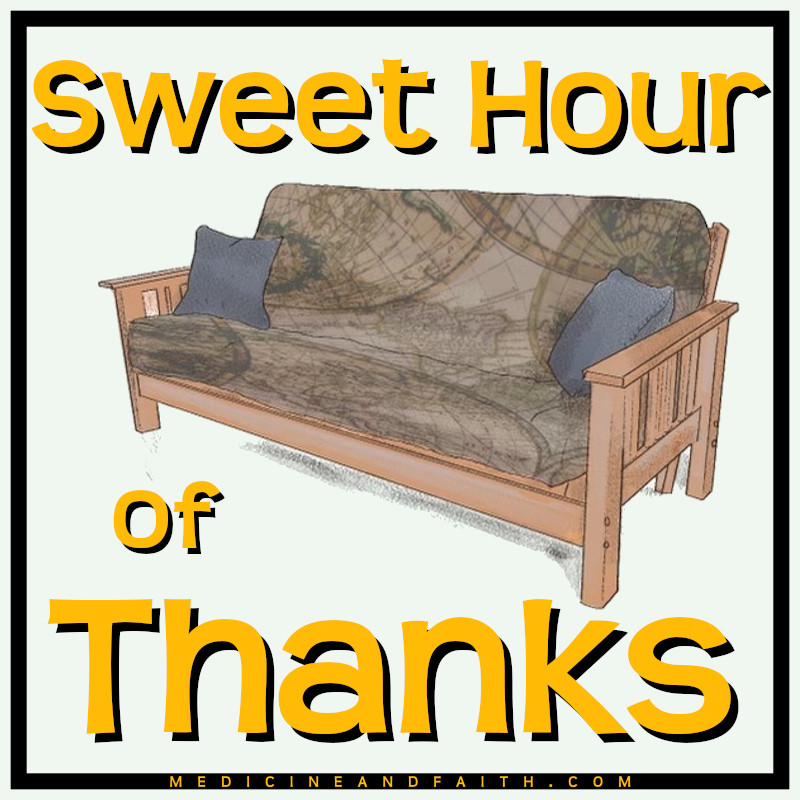
“Yeah,” I said. “My mother-in-law is coming to town, and we need a place for her to sleep.” We walked past a row of couches and stopped in front of a nice wooden frame futon with a thick mattress. The price tag said $100. I stood and stared. My mouth dropped open. It was … perfect. It was manna from heaven.
And it was no less a miracle that it fit in the back of my minivan.
~~~
Marisa squealed when I came home with my prize. We made room for it in our very small living room, and it looked pretty good crammed in there next to our other secondhand furniture. I took the slightly bent metal futon frame to the thrift store and donated it.
That evening we went through our normal bedtime routine. Marisa was on toddler duty while I made a dumpster run with the baby. Could we really expect to find another prize on a day that had already been so blessed? I looked anyway. You never know.
There was much to be grateful for on that day. I was grateful to the generous people who had donated such a nice futon to the thrift store. I was thankful to the people on the admissions committee at the medical school for giving me a chance to become a doctor. I was thankful to generous family members and friends who had supported us in so many ways. I was thankful to have a wife who loved me, and healthy, happy children. Most of all I was thankful to God. This futon miracle felt like a bread crumb blessing – a sign that we were following the right path.
My baby girl liked it when I sang to her. I steadily worked through my repertoire of hymns and children’s songs as we made our way from one dumpster to the next. When I sang “Sweet Hour of Prayer” I remembered my earlier petition to the Lord that day, making my wants and wishes known, and how in my little season of distress and grief my soul had found relief. When the song was over I wanted to keep singing, and I felt like the song was missing an important message, so I wrote another verse:
Sweet hour of prayer
Sweet hour of prayer
When God did all my wounds repair
I sang through thee my song of praise,
Acknowledged him in all my ways.
And ever when he blesses me —
When lame, I walk; when blind, I see —
My love and joy through thee I’ll share
In gratitude, sweet hour of prayer,
My love and joy through thee I’ll share
In gratitude, sweet hour of prayer
~~~
In the two years we lived in that apartment complex we had quite a haul from the dumpsters: a patio set, a few bicycles, a couch, some plastic plants, a nice umbrella, and several small pieces of furniture. We don’t do a lot of dumpster diving any more, but we still go to the thrift store all the time. In fact, even as I type this I am standing beside a used couch that Marisa is buying for $65. It will replace the old one we bought here a few years ago.
After nearly a decade of faithful service to our family, including two moves and heavy abuse by the children, we gave the miracle futon away to our friends who needed it for their visiting parents to sleep on. Marisa was a bit reluctant to let it go because it was proof of our charmed and blessed life, and the mother of the family we gave it to could sense her hesitation. Upon hearing the story of how the futon came to our family, this woman asked, “Are you sure you want to give this away?”
“I’m sure I want to bless you with it,” Marisa said.
We have had a lot of bread crumb blessings over the years. Sometimes these have been temporal or financial, like the futon, and other times they have been spiritual or emotional. Through the ups and downs of my life — the joys and burdens of parenthood, the pressure cooker of medical education, the learning experience of serving in the Church — God has always been there for me. And so I offer a prayer of thanks to him again this day, and every day.
Note: This post is a significant revision of a previous post from 2019.
Alan B. Sanderson, MD is a member of The Church of Jesus Christ of Latter-day Saints and is a practicing neurologist. Illustration by Marisa Sanderson.



 Medicine and Faith
I slept on that futon too! And now we have given you a few. I love your verse to “Sweet hour of prayer”
LikeLike
So beautifully written. It was an inspiring family history story.
Mariam
LikeLike
Love this so much, miss your sweet family!
Dave Stone
LikeLike
Thank you for sharing such a sweet, uplifting memory about faith, blessings and gratitude. Such a good read!
LikeLiked by 1 person
God wants us to learn to have faith. Your during experience was a step towards that goal and makes for a great memory.
LikeLike