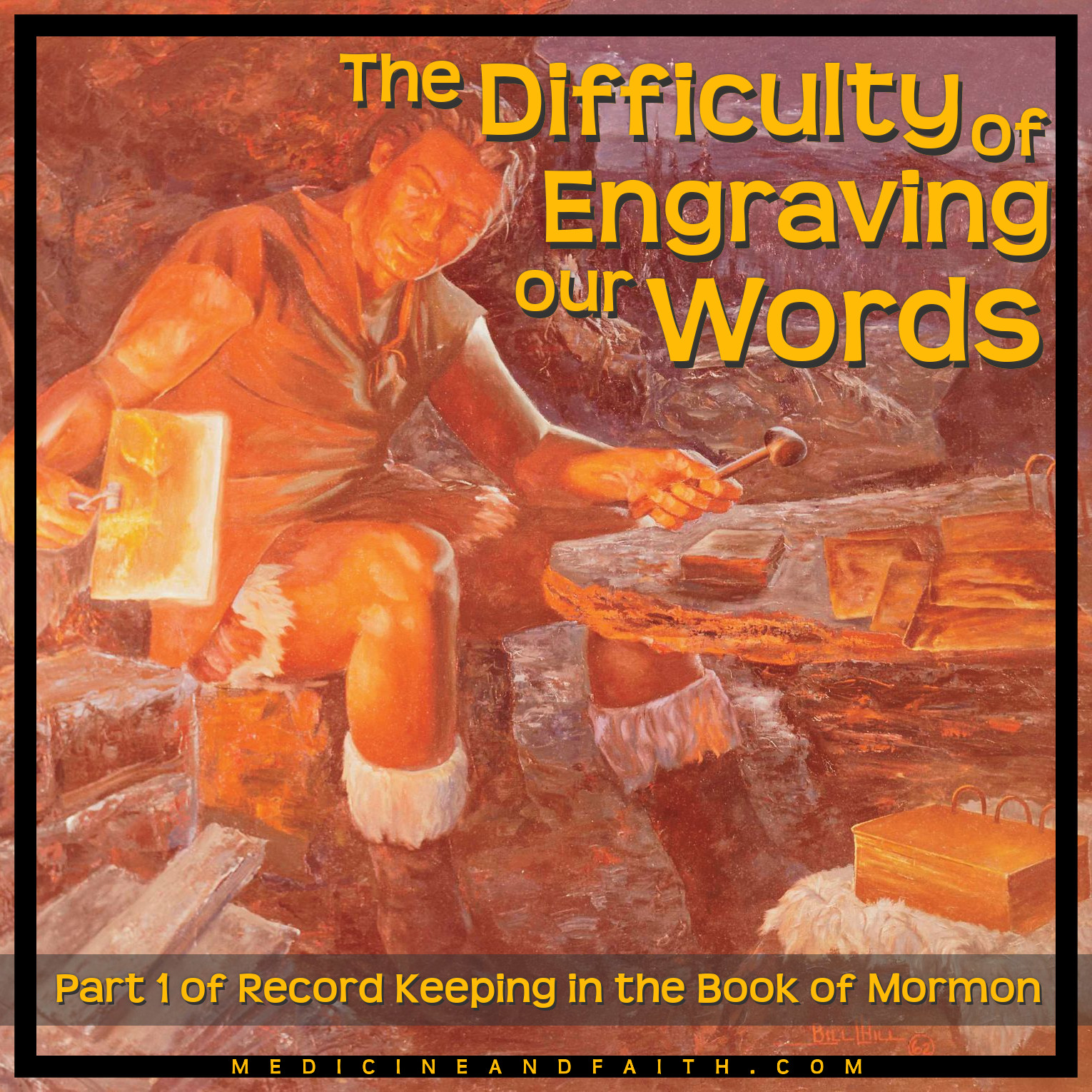
This is the introductory post of a three-part series about record keeping in the Book of Mormon:
- The Difficulty of Engraving Our Words
- Written by Way of Commandment
- The Record Which I Make is True
In previous posts I have focused on the historical chronology, questions, verbs, and narrator comments in the Book of Mormon. While I was studying the narrator comments I marked many passages in which the narrator told us something about how and why he was keeping these records. It was a bigger topic than what I could adequately review in a single section of that post about narrator comments, so I decided to make an isolated study of record keeping in the Book of Mormon. When I started writing about what I learned there was so much material that I decided to break it up into a trilogy.
Methods
I started by reading a fresh copy of the Book of Mormon with pencil in hand, marking those passages that pertained to record keeping. Once I had made a complete pass through the book, I copied each marked passage into a computer spreadsheet, where I categorized each one. According to my tabulation there are 277 verses in 110 passages in which the writer describes some aspect of their record keeping.
If you would like a copy of the spreadsheet I used, please contact me.
Language and Technology
So what can we learn from these passages? First of all that keeping these records was no easy task! Consider this quotation from Jacob, the brother of Nephi:
“1 Now behold, it came to pass that I, Jacob, having ministered much unto my people in word, (and I cannot write but a little of my words, because of the difficulty of engraving our words upon plates) and we know that the things which we write upon plates must remain;
“2 But whatsoever things we write upon anything save it be upon plates must perish and vanish away; but we can write a few words upon plates, which will give our children, and also our beloved brethren, a small degree of knowledge concerning us, or concerning their fathers—
“3 Now in this thing we do rejoice; and we labor diligently to engraven these words upon plates, hoping that our beloved brethren and our children will receive them with thankful hearts, and look upon them that they may learn with joy and not with sorrow, neither with contempt, concerning their first parents.
“4 For, for this intent have we written these things, that they may know that we knew of Christ, and we had a hope of his glory many hundred years before his coming; and not only we ourselves had a hope of his glory, but also all the holy prophets which were before us” (Jacob 4:1-4, emphasis added).
This was difficult, labor-intensive work! How often would I write in my journal if I had to engrave it on metal plates? And what if I had to extract and refine the ore myself? I wonder how Jacob felt when he realized that his brother Nephi had written with his own hand 132 verses — about 40% of all we have — of Jacob’s teachings?
But these men were writing their testimonies and prophecies of Christ. There is no subject of greater importance; it is worth any expense or exertion.
Here is a summary of what we can learn about the language and technology used by the Book of Mormon writers:
- They used Egyptian characters. (1 Nephi 1:2, Mormon 9:32)
- They engraved their writing on metal plates that they made by hand (1 Nephi 1:3, 1 Nephi 1:17, 1 Nephi 9:1-5, 1 Nephi 19:1-6, 2 Nephi 4:14-15, 2 Nephi 5:29-33, Jacob 1:1-4, Jacob 3:14, Jacob 4:1-3, Omni 1:9, Alma 37:2, 3 Nephi 5:10-11, Mormon 1:4, Mormon 2:18, Mormon 8:5, Ether 4:4, Ether 5:2)
- The work was difficult and time-consuming. (2 Nephi 25:23, Jacob 4:1-3, Ether 12:40)
- The writers struggled to express themselves in the language. (1 Nephi 19:6, 2 Nephi 33:4, 3 Nephi 5:18, Mormon 8:17, Mormon 9:31-33, Ether 12:23-25)
- They buried records to preserve them. (4 Nephi 1:48-49, Mormon 1:2-4, Mormon 2:17, Mormon 4:23, Mormon 8:4, Mormon 8:14-16, Ether 4:3)
- They expected the records to eventually be translated by the power of God. (Mormon 9:34, Ether 3:22-24, Ether 4:5-6, Ether 5:1)
When you are writing on metal plates with some kind of stylus there is no spell check, autocorrect, backspace, or eraser. Some passages in the Book of Mormon suggest that the writer made an engraving error. I think the clearest example is this verse:
“And thus we see that, when these Lamanites were brought to believe and to know the truth, they were firm, and would suffer even unto death rather than commit sin; and thus we see that they buried their weapons of peace, or they buried the weapons of war, for peace” (Alma 24:19, emphasis added).
It seems that he meant to write “they buried their weapons of war” but accidentally wrote “weapons of peace.” I can imagine Mormon staring down at the plate for a moment after making this mistake and trying to decide whether to start over with engraving that entire plate or to try a workaround. This one was salvageable, so he went for the workaround. Little phrasing errors like this are compatible with the description these men gave of the technology and tools they used for the work.
Passing the Torch
There are 34 passages, comprising 54 verses, in which the writer describes how the record keeping duties were passed from one person to another. Nephi gave the pattern for how this should be done:
“And this have I done, and commanded my people what they should do after I was gone; and that these plates should be handed down from one generation to another, or from one prophet to another, until further commandments of the Lord” (1 Nephi 19:4, emphasis added).
Notice that his rule was flexible, allowing for discretion. Nephi set the precedent when he passed the plates to his brother Jacob, who was his successor as the spiritual leader of the people. Most of the time the plates were passed from father to son, but there were three occasions when the successor was a brother of the previous writer (Jacob 1:1-4, Omni 1:8, Alma 63:1), one when the recipient was a nephew (Shiblon to Helaman II), and three when records were passed on to someone who appeared to have no immediate relation to the previous possessor (Omni 1:25, Mosiah 22:14, Mormon 1:2-4). The most important thing is not the relationship between the two people, but whether the recipient is a prophet.
This instruction seems to have fallen by the wayside during a time of apostasy in the Book of Omni, where several writers seem to lack any spiritual power or testimony of the work they are doing, and where Omni admits that he is “a wicked man, and I have not kept the statutes and the commandments of the Lord as I ought to have done” (Omni 1:2).
The most detailed description we have of passing the plates from one person to another is in Alma chapter 37, where Alma instructs his son Helaman:
“1 And now, my son Helaman, I command you that ye take the records which have been entrusted with me;
“2 And I also command you that ye keep a record of this people, according as I have done, upon the plates of Nephi, and keep all these things sacred which I have kept, even as I have kept them; for it is for a wise purpose that they are kept. […]
“15 And now behold, I tell you by the spirit of prophecy, that if ye transgress the commandments of God, behold, these things which are sacred shall be taken away from you by the power of God, and ye shall be delivered up unto Satan, that he may sift you as chaff before the wind.
“16 But if ye keep the commandments of God, and do with these things which are sacred according to that which the Lord doth command you, (for you must appeal unto the Lord for all things whatsoever ye must do with them) behold, no power of earth or hell can take them from you, for God is powerful to the fulfilling of all his words.
“17 For he will fulfil all his promises which he shall make unto you, for he has fulfilled his promises which he has made unto our fathers.
“18 For he promised unto them that he would preserve these things for a wise purpose in him, that he might show forth his power unto future generations.
“19 And now behold, one purpose hath he fulfilled, even to the restoration of many thousands of the Lamanites to the knowledge of the truth; and he hath shown forth his power in them, and he will also still show forth his power in them unto future generations; therefore they shall be preserved.
“20 Therefore I command you, my son Helaman, that ye be diligent in fulfilling all my words, and that ye be diligent in keeping the commandments of God as they are written” (Alma 37:1-2, 15-20, emphasis added).
This is a solemn charge, complete with promised blessings if he executes the charge faithfully and promised cursings if he doesn’t. Alma gives Helaman the long view of their purpose in keeping these records, and points out some of the miracles that they have already seen through their efforts. In short, the task of keeping sacred records is the work of God, done under his command and upheld by his power.
Meet the Author
Who wrote this book? Many of the authors of the Book of Mormon introduced themselves to their readers. Most of these author introductions are brief, such as those found throughout the Book of Omni, and consist of little more than the name of the writer and his relationship to a previous or subsequent writer.
Many writers contributed to the book, but three of them did most of the work. Counting the number of chapters from each writer, Mormon wrote 61%, Nephi wrote 23%, and Moroni wrote 11% of the book. (All other authors combined wrote about 5%.) These three principal authors wrote the most interesting self-introductions.
Nephi introduces himself in the introduction and in the first verses of his first book. From these passages we learn that he was taught literacy and religion by his parents, that he wrote the story of his own experiences, and that he had firsthand knowledge of the Lord. He had experienced “many afflictions” but can testify that God has been good to him.
Mormon has three introductions. The first one comes in the Words of Mormon, where we learn that he lived hundreds of years after most of the events that he wrote about. He lived at the end of his civilization, on the eve of their destruction. His second introduction comes in Third Nephi, where he paused for a longer introduction. Here we learn that he is a disciple of Jesus Christ, that his name comes from a story in their religious history, and that he is a direct descendant of Lehi, the father of Nephi. Mormon’s third introduction is when he comes to the history of his own day. There he writes the story of how he came to be the steward of all of the Nephite records.
Moroni introduces himself in Mormon chapter 8, where we learn that he is the last survivor of his nation, and that he will be the final writer in the record.
“Behold, my father hath made this record, and he hath written the intent thereof. And behold, I would write it also if I had room upon the plates, but I have not; and ore I have none, for I am alone. My father hath been slain in battle, and all my kinsfolk, and I have not friends nor whither to go; and how long the Lord will suffer that I may live I know not” (Mormon 8:5).
How can we summarize these three men? First, their perspectives were shaped by their extraordinary experiences, having witnessed the beginning and the end of a great civilization. Nephi was present at the beginning, but also saw the eventual destruction of his people in vision. Mormon and Moroni lived at the time of this destruction, but they knew the full history of their people back to the beginning. They were descended directly from the great patriarch of both Nephite and Lamanite nations.
Second, just from their introductions we know that all three of these men faced serious challenges in their lives, including terrible grief. We can relate to them because they know what it means to suffer. Their testimonies can help us make it through the hard times in our lives.
Focusing on the character of Mormon, the majority author, we can learn something about the character of this book. Mormon’s record keeping mentor, the man who passed the records on to him, noticed that when Mormon was ten years old he was “a sober child, and … quick to observe” (Mormon 1:2). The Book of Mormon is a sober book. It is not intoxicated with levity, flippancy, or any kind of unseriousness. It is also an observant book, commenting frequently on the greater lessons of each event in its history.
Mormon’s calling as a disciple of Christ was equivalent in their church organization to that of an apostle, or special witness of Christ. Thus, the Book of Mormon is Another Testament of Jesus Christ, equal in authority to the writings of the apostles in the Bible.
Mormon was named after the waters of Mormon, a place that represents the joy of coming unto Christ. Those who were baptized by Alma had a special love for the place where they had heard the gospel preached, and where they had first made covenants to follow Jesus. The Book of Mormon is, for me, like the waters of Mormon. While studying these verses, my eyes glued to the pages, I “came to the knowledge of [my] Redeemer” (Mosiah 18:30).
Part 2 of this series will will expand on some of the themes introduced in the passage from Alma 37 quoted above, namely: the motivation or ultimate purpose the writers had for doing this work, and the divine mandate they operated under.
Cover art: Nephi Fashioning the Plates, by Bill L. Hill
Alan B. Sanderson, MD is a member of The Church of Jesus Christ of Latter-day Saints and is a practicing neurologist.




 Medicine and Faith