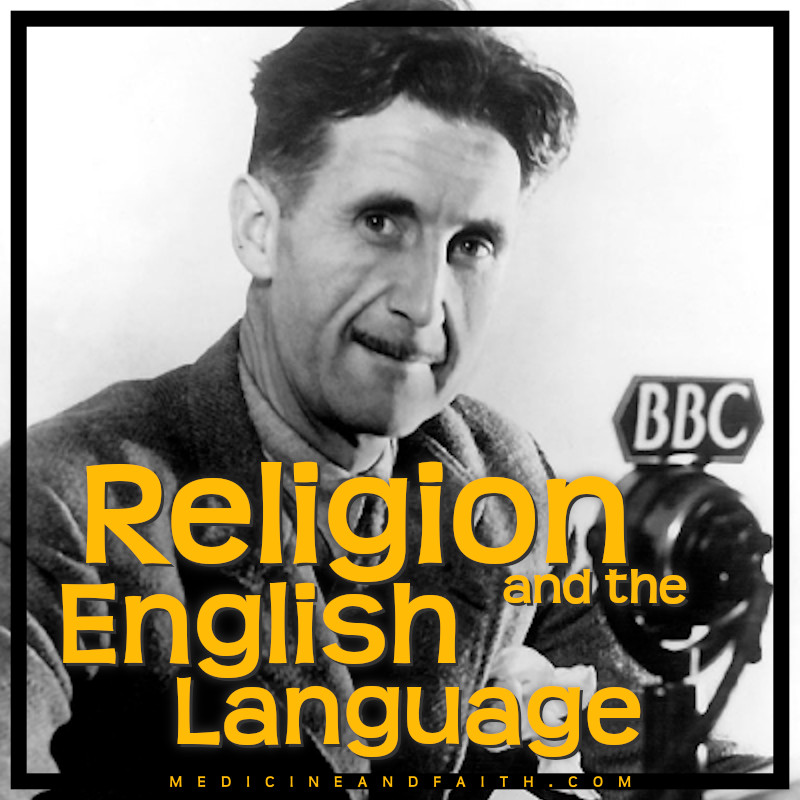
One of the great observations of George Orwell (1903-1950) was that the language we use influences how we think.
“It [language] becomes ugly and inaccurate because our thoughts are foolish, but the slovenliness of our language makes it easier for us to have foolish thoughts. The point is that the process is reversible. Modern English, especially written English, is full of bad habits which spread by imitation and which can be avoided if one is willing to take the necessary trouble. If one gets rid of these habits one can think more clearly […]
“But if thought corrupts language, language can also corrupt thought. A bad usage can spread by tradition and imitation, even among people who should and do know better” (from Politics and the English Language, 1946).
This concept is consistent with neuroscience. We often use the language centers of the brain to formulate our thoughts, so our thoughts follow the contours of our language. Many writers say that they don’t know what they think about something until they try to write about it. It follows logically that if you change the language you use, you will change your thinking patterns. Orwell famously applied this insight to his political writing. The deliberate corruption of language is a tool of oppression used by authoritarian governments in his novels.
I recently read a good book that made me realize that I have been thinking incorrectly about politics because I have been using the wrong words to describe it. The Myth of Left and Right: How the Political Spectrum Misleads and Harms America by Verlan Lewis and Hyrum Lewis argues that our terminology of politics as a spectrum of “left” to “right” makes us think, incorrectly, that politics is a unidimensional thing.
But it is not! Even individual policy decisions like taxation, infrastructure, or welfare, are multifaceted. There is no single underlying essence that consistently predicts what policy positions will be preferred by the political parties, and over time the parties have changed positions on many issues. Politics is a tribal or coalitional activity, and the policy positions of each group are socially determined. The past decade has been a time of change for the major parties in the United States, not because they are moving left or right on an imaginary spectrum but because they are reacting to current events and changing their voter coalitions as different leaders rise to power.

My thinking about politics was previously limited by the language I was using. I can think more clearly now that I have gotten rid of the habit of talking about politics as a spectrum. As a result I am less pessimistic and more willing to find places where I can agree with people.
~~~
The principle that language influences thought also applies to religion. People require clarity of communication in order to understand their relationship with God. Let me share a few recent examples, each one a quote from the General Conference of The Church of Jesus Christ of Latter-day Saints.
1. The Atonement of Jesus Christ
“It is doctrinally incomplete to speak of the Lord’s atoning sacrifice by shortcut phrases, such as ‘the Atonement’ or ‘the enabling power of the Atonement’ or ‘applying the Atonement’ or ‘being strengthened by the Atonement.’ These expressions present a real risk of misdirecting faith by treating the event as if it had living existence and capabilities independent of our Heavenly Father and His Son, Jesus Christ.
“Under the Father’s great eternal plan, it is the Savior who suffered. It is the Savior who broke the bands of death. It is the Savior who paid the price for our sins and transgressions and blots them out on condition of our repentance. It is the Savior who delivers us from physical and spiritual death.
“There is no amorphous entity called “the Atonement” upon which we may call for succor, healing, forgiveness, or power. Jesus Christ is the source. Sacred terms such as Atonement and Resurrection describe what the Savior did, according to the Father’s plan, so that we may live with hope in this life and gain eternal life in the world to come. The Savior’s atoning sacrifice—the central act of all human history—is best understood and appreciated when we expressly and clearly connect it to Him” (Russell M. Nelson, April 2017 General Conference).
I remember thinking at the time he said this that President Nelson was perhaps being a little too pedantic. Don’t we all know that the Atonement is what Jesus did? Was there really a great danger of separating our understanding of the Atonement from the person who accomplished it?
But do you see what I did in that last sentence? I referred to the Atonement as something distinct from Jesus Christ, which it is not.
Jesus said, “I am the way, the truth, and the life: no man cometh unto the Father, but by me” (John 14:6). The same message is taught in the Book of Mormon: “And moreover, I say unto you, that there shall be no other name given nor any other way nor means whereby salvation can come unto the children of men, only in and through the name of Christ, the Lord Omnipotent” (Mosiah 3:17).
President Nelson uses language with surgical precision, and I think there is more to it than just the fact that he is a surgeon. He understands that to think correct thoughts you must use correct language.
2. The Priesthood and the Men of the Church
“The priesthood is a divine power and authority held in trust to be used for God’s work for the benefit of all of His children. Priesthood is not those who have been ordained to a priesthood office or those who exercise its authority. Men who hold the priesthood are not the priesthood. While we should not refer to ordained men as the priesthood, it is appropriate to refer to them as holders of the priesthood” (Dallin H. Oaks, April 2020 General Conference).
President Oaks has made at least three similar statements in General Conference over the last twenty years (2005, 2014, and 2018), and other apostles have also given the same teaching. Why is this important? I can think of a few reasons.
First, because using the same term to refer to God’s power and a group of men muddles the meaning in a way that is not useful. It is like referring to tires as “the car.”
Second, the work done by men and women in temples and in Church organizations and classes is done by God’s power, delegated through the organization of his Church. The fifth Article of Faith applies as much to the work of women in the Church as to the work of men.
“We believe that a man [or woman] must be called of God, by prophecy, and by the laying on of hands by those who are in authority, to preach the Gospel and administer in the ordinances thereof” (Articles of Faith 1:5).
A third reason to distinguish between the priesthood and the men who hold it is that men are weak and imperfect. The failings of men should not be ascribed to our Heavenly Father, whose love for his children is perfect. Mortal men may abuse you, but God never will.
President Oaks is a lawyer and a judge. He knows that words have meaning. But he also knows how valuable this message is — how much it can change the hearts and lives of those who hear it — so he takes care to communicate with legal precision.
3. The Correct Name of the Church
“What’s in a name or, in this case, a nickname? When it comes to nicknames of the Church, such as the ‘LDS Church,’ the ‘Mormon Church,’ or the ‘Church of the Latter-day Saints,’ the most important thing in those names is the absence of the Savior’s name. To remove the Lord’s name from the Lord’s Church is a major victory for Satan. When we discard the Savior’s name, we are subtly disregarding all that Jesus Christ did for us—even His Atonement. […]
“When we omit His name from His Church, we are inadvertently removing Him as the central focus of our lives” (October 2018 General Conference).
Longtime readers of this blog will know that I took President Nelson’s teachings about the name of the Church seriously, rebranding this site not once, but twice. (I think I got it right the second time.) Using the correct name of the church has changed the way I think about myself as a Church member and as a disciple of Christ.
The Church of Jesus Christ of Latter-day Saints today has far more spiritual power than the “Mormon Church” I grew up in. Why? Because now we are more focused on the source of that power.
~~~
All three of the examples I have shared here are about putting God first in our lives. This is basic, fundamental stuff.
“Thou shalt have no other gods before me” (Exodus 20:3).
“Thou shalt love the Lord thy God with all thy heart, and with all thy soul, and with all thy mind. This is the first and great commandment” (Matthew 22:37-38).
It is hard enough to develop faith in Jesus Christ without our “slovenly” or “foolish” language subtly suggesting that he is not the one who saves us, or that he has no real power to bless us, or that his restored Church is actually some man-made organization focused on someone or something else. But if we “[get] rid of these habits [we] can think more clearly.”
Part of the reason the Lord restored his Church in the latter days was so “that every man might speak in the name of God the Lord, even the Savior of the world; That faith also might increase in the earth” (Doctrine and Covenants 1:20-21). My faith in Jesus Christ has increased as I have followed the counsel of our prophets and apostles to speak more accurately about God the Lord.
The goal is not to be the language police. It is to remember the Lord, who promised, “And if ye do always remember me ye shall have my Spirit to be with you” (3 Nephi 18:7).
Cover image: George Orwell
Alan B. Sanderson, MD is a member of The Church of Jesus Christ of Latter-day Saints and is a practicing neurologist.



 Medicine and Faith
