
Last month I drove from southern Utah to San Diego to attend the annual meeting of the American Academy of Neurology (AAN). On the way I decided to do a couple things in eastern Nevada that have been on my to-do list for a while.
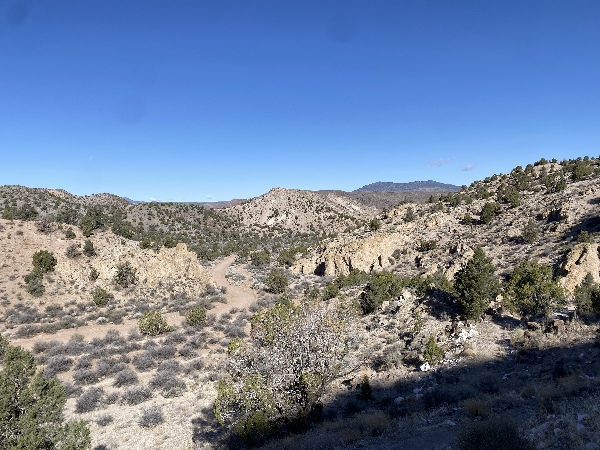
First I went running on a mountain bike trail just east of Caliente. I had to drive a few miles from town on a canyon road that quickly turned to dirt and gravel, and there were several crossings of a stream that was full with spring runoff. One of these was deep enough and wide enough to make me a little nervous to ford it in my Volkswagen Jetta. I just gunned it and made it over OK.
At the trail head there was a city worker spraying weeds. He told me to stay away from all the places he had sprayed, marked blue by dye in the spray. I felt bad for the guy, and hoped that he wouldn’t get Parkinson disease from all of the chemical exposure.
The trail was pretty good. I had the entire network of trails to myself. I guess no one drives out to the middle of nowhere on a random Friday morning in April to go running on trails. Except me. I think these trails will be too hot in summer, though. This is probably the right time of year to be there.
There is something about running in a natural setting that just feels right. There is good evidence from comparative anatomy and physiology studies that distance running was an important part of hominid evolution. I imagine that my ancestors have been running through natural terrain like this for the last 2 million years (when Homo erectus appears in the fossil record). Being out in the wild, among the plants and rocks and lizards, gives me a primal sense of well-being. Everything is as it should be. I really wouldn’t trade it for anything.



After my run I drove back up the dirt road, over the several stream crossings, and back to the highway. The next town south was Alamo, where my grandmother was born and had her earliest memories. Her grandmother, Lucinda Araminta Stewart Brown, was a nurse midwife in Alamo for decades. She was probably the first healthcare worker in that area during modern times.
I stopped at the cemetery (which was surprisingly difficult to find – Google Maps wanted me to go through a private road that was blocked off), where I found a family reunion of deceased Stewart cousins. Lucinda’s brother was the founder of the town and its first bishop. I was surprised to find the grave of Artemacy Wilkerson Stewart, Lucinda’s maternal aunt who was also a wife of her father. I didn’t know that she had lived in Alamo. (The word “aunt” was used by children in plural families to refer to the other wives of their father, so Artemacy was Lucinda’s aunt in both senses.)
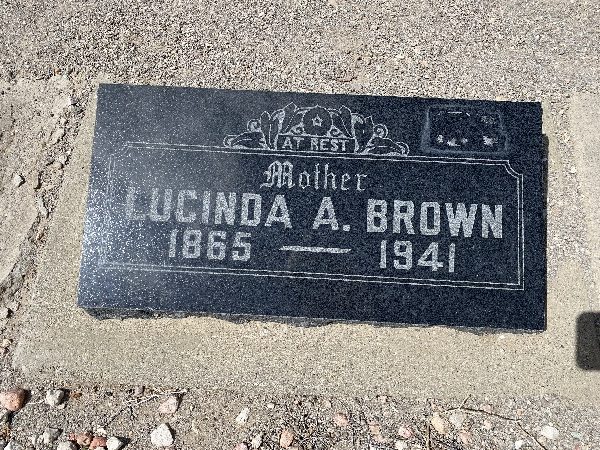
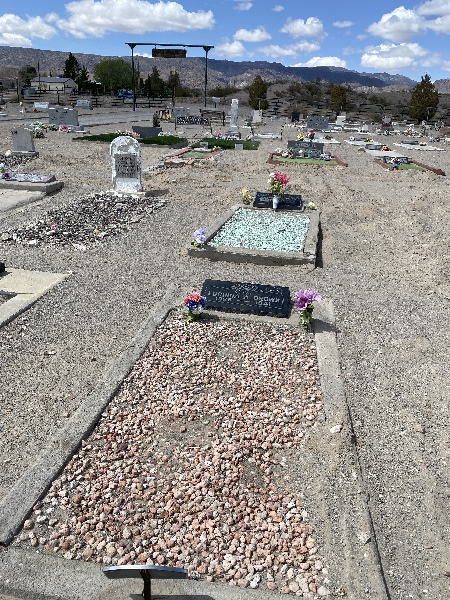
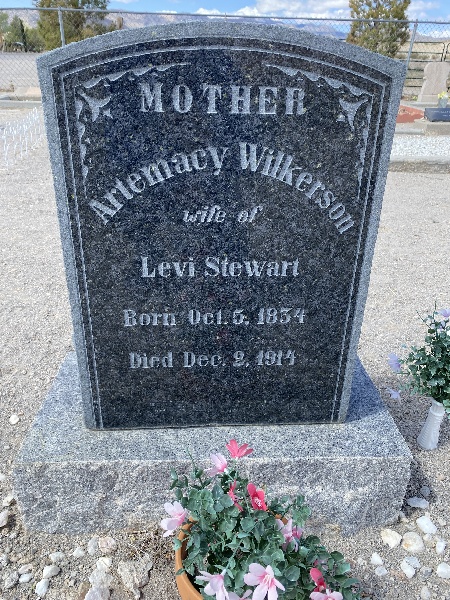
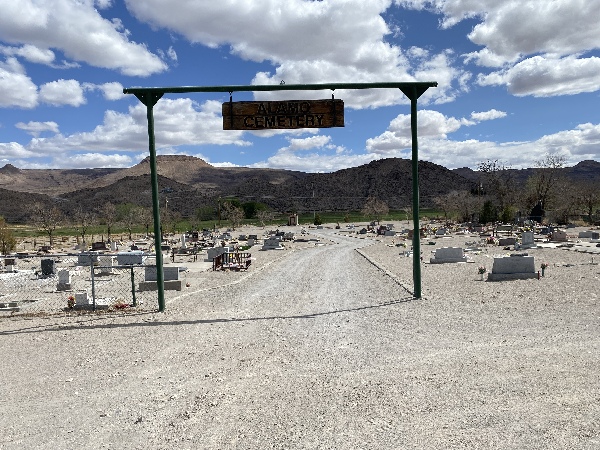
As far as I know I am the only member of my family line to visit Alamo in over 80 years. Grandma Glenna wrote this in her life sketch of Lucinda:
We visited her in Alamo in late summer 1941. She was not well, we learned later; a black widow spider bite had exacerbated her heart condition, yet she was determined to have the house ready for our visit, and to prepare special food. She passed away about three months later, in November of 1941 at Helma’s home in Las Vegas.
I asked Helen why Grandma was not buried in her plot in Fredonia near her husband. The reason was that Emma (her husband’s first wife) had buried a son of hers there. So Grandma had requested, “I want to be buried in Alamo where I am really loved.” Aunt Emma lived to be over 100. When Helen visited her after Grandma’s funeral, she said “Aunt Emma cried and cried. I told her, ‘Why she is happy now.’ Aunt Emma cried deep down sobs, then said, ‘It’s not that. But now – she will get the first kiss.’ (SIC)”
What a hard life these people lived! They eked out a subsistence in the desert without air conditioning, with only rudimentary indoor plumbing, suffering through grinding poverty, constant work, and venomous wildlife. They sacrificed their feelings to obey the law of plural marriage, dealing with the natural jealousies that it enraged to marry a man old enough to be Lucinda’s father, only to have the Church discontinue the practice a few years later.
And yet, this is how Grandma Glenna summarized the life of her grandmother:
Her life was given in loving service, and she hungered and thirsted after the word of the Lord and after all righteousness. She lived with love and light, with peace and delight – as Nephi said, “after the manner of happiness” (2 Nephi 5:27).
I suppose it is a little inconsistent to romanticize the distance running of my primitive ancestors but to pity the hard life of my great-great grandmother, who lived in relative comfort and ease compared to grandpa H. erectus. My children and grandchildren will be unable to comprehend my childhood without the internet. They will struggle to understand how I could have been truly happy in the same way that I am intrigued at the happiness of Grandma Lucinda.
After my stroll through the Alamo Cemetery I got back in the car and drove the rest of the way to San Diego, stopping only briefly at a gas station in Primm. What would H. erectus or Lucinda Brown think of that journey?
And what about my descendants, with their flying cars and other gizmos? I hope they learn about what really makes people happy. (Hint: it is not our technology.)
Alan B. Sanderson, MD is a member of The Church of Jesus Christ of Latter-day Saints and is a practicing neurologist.



 Medicine and Faith