A couple of years ago I took a cross-country road trip with my son, who had just finished serving his mission. Along the way we visited places in Missouri, Illinois, Ohio, New York, and Pennsylvania which were important in the history of The Church of Jesus Christ of Latter-day Saints.
In the town center of Palmyra, in western New York, is the E. B. Grandin Printshop, where the first edition of the Book of Mormon was printed in 1830. We stood in the room where the book was manually type set one character at a time, then inked and pressed, and folded into little booklets, which were sewn together, planed, and bound. The technology they used was cutting-edge at the time, but it involved a tremendous amount of tedious and detailed work.
I picked up a replica of the 1830 edition at a nearby bookstore and started thumbing through it that day. When I returned home I decided to make a serious study of the first edition side-by-side with the current edition. This post will summarize what I learned. You can read the entire 1830 edition at the Joseph Smith Papers website, photographed from an original copy.
The first printing of the Book of Mormon is a fascinating time capsule of language. There are three main influences on its language and style:
- It was written 1500 years before it was published, by people who spoke a Hebraic language and who wrote using Egyptian characters (see Mormon 9:32-33).
- The English language translation in 1829 aspired to echo the style of the King James Bible, which was the standard scriptural text at the time. (It is interesting to note that the King James translation was about as old in the early 1800’s as the Book of Mormon is today.)
- The book’s translator was a poorly educated young man from a backwoods community, who, according to his wife, “could neither write nor dictate a coherent and well-worded letter; let alone dictating a book like the Book of Mormon.”
All three of these influences are evident in the 1830 edition, but as we’ll see, that last one has been attenuated through subsequent editing.
This post is very long, and I don’t expect every word of it to be interesting to everyone who reads it. Feel free to skip ahead to the conclusions at the bottom if your eyes start to glaze over.
Other posts about scripture study:



Something went wrong. Please refresh the page and/or try again.
General Layout and Chapter Groupings
The first thing one notices about the 1830 edition of the Book of Mormon is that there are no verses; the text is arranged in paragraph form. Some of these paragraphs are exceptionally long: the letter written by Moroni to Pahoran in Alma chapter 60 is a single paragraph that spans over 3.5 pages. Page headers only contain the page number and not the book name or chapter number, so you can’t tell at a glance where you are when you open to a random page and you have to scan the text for context clues.
At the front of the book, on the back side of the Title Page, is a copyright notice which actually quotes the entirety of the previous page. There is also a Preface by Joseph Smith which describes the missing 116 pages and quotes a passage from Doctrine & Covenants Section 3, condemning those who stole the pages. I like the current Introduction better.
The testimony of three and eight witnesses are at the back of the book instead of their current place in the beginning, because the front of the book had already been printed by the time the witnesses were selected in March 1830.
Chapter breaks were specified in the printer’s manuscript of the Book of Mormon, but they differ significantly from our current edition. I don’t know whether the original chapters were determined by the Nephite writers, by Joseph Smith, or by his scribes. The following table is a comparison of chapter breaks in the 1830 printing and the current edition. Note that the 1830 edition uses Roman numerals for chapter numbers.
| Book | 1830 Chapter | Current Chapter(s) |
|---|---|---|
| 1 Nephi | I | 1 — 5 |
| II | 6 — 9 | |
| III | 10 — 14 | |
| IV | 15 | |
| V | 16 – 19:21 | |
| VI | 19:22 – 21 | |
| VII | 22 | |
| 2 Nephi | I | 1 — 2 |
| II | 3 | |
| III | 4 | |
| IV | 5 | |
| V | 6 — 8 | |
| VI | 9 | |
| VII | 10 | |
| VIII | 11 — 15 | |
| IX | 16 — 22 | |
| X | 23 — 24 | |
| XI | 25 — 27 | |
| XII | 28 — 30 | |
| XIII | 31 | |
| XIV | 32 | |
| XV | 33 | |
| Jacob | I | 1 |
| II | 2 — 3 | |
| III | 4 — 5 | |
| IV | 6 | |
| V | 7 | |
| Enos | I | 1 |
| Jarom | I | 1 |
| Omni | I | 1 |
| Words of Mormon | I | 1 |
| Mosiah | I | 1 — 3 |
| II | 4 | |
| III | 5 | |
| IV | 6 | |
| V | 7 — 8 | |
| VI | 9 — 10 | |
| VII | 11 – 13:24 | |
| VIII | 13:25 – 16 | |
| IX | 17 — 21 | |
| X | 22 | |
| XI | 23 — 27 | |
| XII | 28:1-19 | |
| XIII | 28:20 – 29 | |
| Alma | I | 1 — 3 |
| II | 4 | |
| III | 5 | |
| IV | 6 | |
| V | 7 | |
| VI | 8 | |
| VII | 9 | |
| VIII | 10 — 11 | |
| IX | 12 – 13:9 | |
| X | 13:10 – 15 | |
| XI | 16 | |
| XII | 17 — 20 | |
| XIII | 21 — 22 | |
| XIV | 23 — 26 | |
| XV | 27 — 29 | |
| XVI | 30 — 35 | |
| XVII | 36 — 37 | |
| XVIII | 38 | |
| XIX | 39 — 42 | |
| XX | 43 — 44 | |
| XXI | 45 — 49 | |
| XXII | 50 | |
| XXIII | 51 | |
| XXIV | 52 — 53 | |
| XXV | 54 — 55 | |
| XXVI | 56 — 58 | |
| XXVII | 59 — 60 | |
| XXVIII | 61 | |
| XXIX | 62 | |
| XXX | 63 | |
| Helaman | I | 1 — 2 |
| II | 3 — 6 | |
| III | 7 — 10 | |
| IV | 11 — 12 | |
| V | 13 — 16 | |
| 3 Nephi | I | 1 — 2 |
| II | 3 — 5 | |
| III | 6 — 7 | |
| IV | 8 — 10 | |
| V | 11 – 13:24 | |
| VI | 13:25 – 14 | |
| VII | 15 — 16 | |
| VIII | 17 — 18 | |
| IX | 19 – 21:21 | |
| X | 21:22 – 23:13 | |
| XI | 23:14 – 26:5 | |
| XII | 26:6 – 27:22 | |
| XIII | 27:23 – 29 | |
| XIV | 30 | |
| 4 Nephi | I | 1 |
| Mormon | I | 1 — 4 |
| II | 4 — 5 | |
| III | 6 — 7 | |
| IV | 8 — 9 | |
| Ether | I | 1 — 4 |
| II | 5 | |
| III | 6 — 8 | |
| IV | 9 — 11 | |
| V | 12 | |
| VI | 13 — 15 | |
| Moroni | I | 1 |
| II | 2 | |
| III | 3 | |
| IV | 4 | |
| V | 5 | |
| VI | 6 | |
| VII | 7 | |
| VIII | 8 | |
| IX | 9 | |
| X | 10 |
Notice that Moroni is the only multi-chaptered book that has exactly the same chapter breaks in the current printing.
Chapters were generally longer in the first edition, and several chapter breaks occur at what is now the middle of a chapter. Biblical passages that are quoted (such as the Isaiah chapters in 2 Nephi) or echoed (such as the Lord’s sermon in 3 Nephi 12-14) do not always follow the standard chapter breaks from the Bible. Many of these longer chapters contain a complete story that is broken up in the current edition, like the sermon in Jacob 2-3 (Jacob chapter II) and Samuel’s prophecy in Helaman 13-16 (Helaman chapter V).
Only 42% of the 114 chapters in the 1830 edition are unchanged in the current edition, but we still use 92% of the original chapter breaks (we just have added additional ones). I suppose that if the 1830 edition had made numbered verses there would be a similar retention of these today.
It’s not hard to imagine different ways of grouping chapters together, or of breaking longer chapters into smaller pieces. For instance, Jacob 5 is the longest chapter in the current edition. The allegory of the olive tree is organized as a pretty standard trilogy, with largely exposition in the first part (verses 1-28), overwhelming setback in the second part (verses 29-49), and eventual triumph in the third part (verses 50-77). Breaking it up this way would produce three chapters with 28, 21, and 28 verses, respectively.
Another long chapter we could imagine breaking up is Alma chapter 5, which is the second-longest chapter in the Book of Mormon. (In the 1830 edition, the first 48 verses of this chapter are lumped into a single paragraph that stretches over 4 pages!) It is a long sermon, but other long sermons in the book are usually broken up (ex: 2 Nephi 6-9). In the long middle section of the chapter (verses 6-30) Alma asks a series of probing questions about the spiritual preparation of his listeners. The tail end of this questioning (verses 30-42) doesn’t have a reasonable break point until verse 43. If you split the chapter there it would create two chapters that are 42 and 20 verses long, respectively. If you wanted to make the first chapter shorter you could put another break after verse 13.
In my opinion the most awkward chapter break in the current edition that was not present in the 1830 printing is the one between Alma 10 and Alma 11. The last two verses of chapter 10 are closely connected to the opening part of chapter 11, and the narrative feels more fluid when those two chapters are combined. However, the combination of the two chapters would be 78 verses, which would make it the longest chapter in the current printing by number of verses (although many of those verses are really short). I suppose the verses which describe the Nephite coinage system (Alma 11:1-19) could be moved to the end of chapter 10, or perhaps spun off into their own chapter.
It would also be possible to combine smaller chapters, like Moroni 2-6, which would make 21 verses when combined. These chapters are usually read together, anyway. It also might make sense to merge Ether 4-5, as chapter 5 is only 6 verses long, completes the subject of the previous chapter, and the two combined would only have 25 verses.
I am not really advocating for any of these changes, just playing in a sandbox — or, maybe, thinking outside of it. The original Nephite authors probably didn’t envision their writings as having quite the structure we have imposed upon them. Some of this structure is necessarily arbitrary, and has been perpetuated by inertia, for convenience of study and reference.
Workflow Errors
The process of writing the translation in the original manuscript, copying the entire text to the printer’s manuscript, and then setting the type for each page, was long and laborious. Multiple errors in the 1830 text can be traced to problems with some part of this workflow.
Transcription Errors
When the Book of Mormon translation was complete Joseph Smith directed Oliver Cowdery to make a complete copy of the manuscript to be used in the printing process. Several transcription errors were made during that copying process, and were incorporated into the 1830 printing. In later printings the original manuscript was compared to the printer’s manuscript, and these errors were corrected. Unfortunately many pages of the original manuscript have been lost or destroyed, so there are likely many more such errors than what we are able to document.
| Verse | Original Manuscript | Printer’s Manuscript and 1830 printing |
|---|---|---|
| 1 Nephi 3:10 | gone | come |
| 1 Nephi 8:18 | and partake of the fruit | (phrase is omitted) |
| 1 Nephi 10:18 | for all men | (phrase is omitted) |
| 1 Nephi 12:5 | not | (word is omitted) |
| 1 Nephi 12:17 | that they perish and are lost | that they may perish and are lost |
| 1 Nephi 13:4-5 | formation | foundation |
| 1 Nephi 13:24 | fulness | plainness |
| 1 Nephi 15:12 | father | fathers |
| 1 Nephi 18:18 | with sorrow | (phrase is omitted) |
| 1 Nephi 19:2 | first | (word is omitted) |
| 1 Nephi 22:4 | behold | before |
| 2 Nephi 1:1 | and rehearsed unto them | (phrase is omitted) |
| 2 Nephi 7:5 | opened | anointed |
| 2 Nephi 30:18 | I make an end of my sayings. | I must make an end of my sayings. |
| Alma 31:30 | infidelity | iniquity |
| Alma 37:18 | preserve | reserve |
| Alma 46:31 | with his tents | (phrase is omitted) |
| Alma 54:1 | commencement of the | (phrase is omitted) |
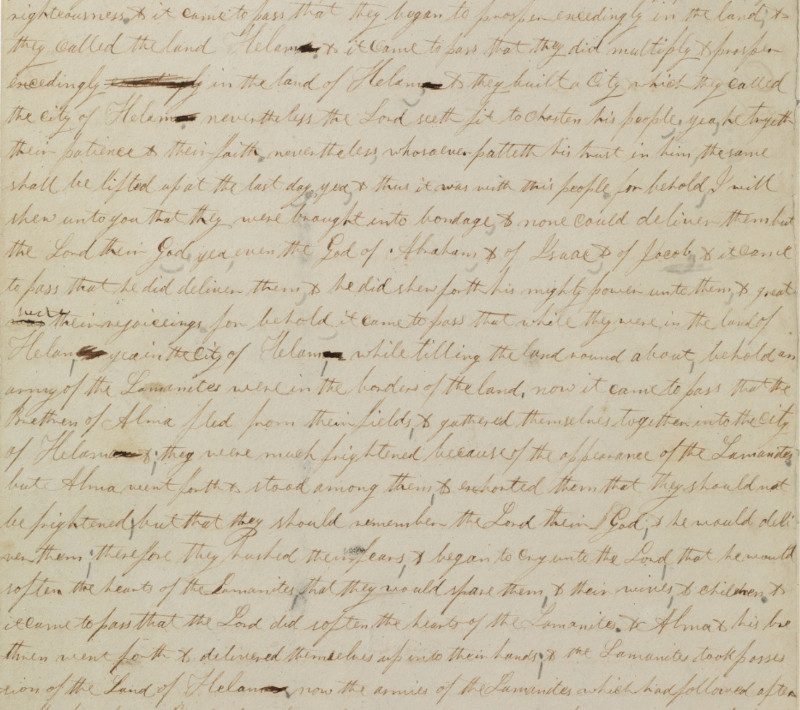
There was an interesting near-miss in Mosiah 18:12-14 and Mosiah 23:19-39, where there are multiple instances of the name “Helam” which were written as “Helaman” in the printer’s manuscript but given as “Helam” in the 1830 printing. These pages are missing from the original manuscript, but on the printer’s manuscript the last two letters of “Helaman” are blotted out in every occurrence. Apparently this correction was made before the first printing of the book.
Punctuation
The original manuscript of the Book of Mormon — handwritten by Oliver Cowdery, Emma Smith, and other scribes as Joseph Smith dictated the translation from the gold plates — did not contain verse markings or even punctuation. E. B. Grandin and his associate John Gilbert provided the punctuation for the first edition, and there are a few places where they apparently got the phrasing wrong. Consider this example from the Title Page:
| 1830: | “… the interpretation thereof by the gift of God; an abridgment taken from the Book of Ether. “Also, which is a record of the people of Jared …” |
| Current: | “… The interpretation thereof by the gift of God. “An abridgment taken from the Book of Ether also, which is a record of the people of Jared …” |
The location of that period and paragraph break makes a big difference! I’m sure the readers of the first edition puzzled over what that meant.
2 Nephi 1:10 has a single comma added in later printings, which subtly changes the meaning of the verse:
| 1830: | “… after that they have received so great blessings from the hand of the Lord ; having a knowledge of the creation of the earth, and all men knowing the great and marvelous works of the Lord from the creation of the world …” |
| Current: | “… after they have received so great blessings from the hand of the Lord—having a knowledge of the creation of the earth, and all men, knowing the great and marvelous works of the Lord from the creation of the world …” |
The final phrase in 2 Nephi 10:9 — “for he hath spoken it, and who can dispute?” — has a period instead of a question mark in the 1830 printing.
A punctuation change and some other revisions make the meaning of Jacob 1:14 much clearer in the current edition:
| 1830: | “But I, Jacob, shall not hereafter distinguish them by these names, but I shall call them Lamanites. They that seek to destroy the people of Nephi, and they which are friendly to Nephi I shall call Nephites, or the people of Nephi …” |
| Current: | “But I, Jacob, shall not hereafter distinguish them by these names, but I shall call them Lamanites that seek to destroy the people of Nephi, and those who are friendly to Nephi I shall call Nephites, or the people of Nephi …” |
The punctuation of Jacob 5:48 has been changed, and the verse has been revised to make it a little more concise:
| 1830: | “And it came to pass that the servant sayeth unto his master, Is it not the loftiness of thy vineyard? Have not the branches thereof overcome the roots, which are good? And because that the branches have overcome the roots thereof? For behold they grew faster than the strength of the roots thereof, taking strength unto themselves. Behold, I say, is not this the cause that the trees of thy vineyard hath become corrupted?” |
| Current: | “And it came to pass that the servant said unto his master: Is it not the loftiness of thy vineyard—have not the branches thereof overcome the roots which are good? And because the branches have overcome the roots thereof, behold they grew faster than the strength of the roots, taking strength unto themselves. Behold, I say, is not this the cause that the trees of thy vineyard have become corrupted?” |
The introduction to the Book of Alma contains this confusing passage:
| 1830: | “The account of Alma, who was the son of Alma the First, and Chief Judge over the people of Nephi, and also the High Priest over the Church. An account of the reign of the Judges, and the wars and contentions among the people. And also an account of a war between the Nephites and the Lamanites, according to the record of Alma the First, and chief judge.” |
| Current: | “The account of Alma, who was the son of Alma, the first and chief judge over the people of Nephi, and also the high priest over the Church. An account of the reign of the judges, and the wars and contentions among the people. And also an account of a war between the Nephites and the Lamanites, according to the record of Alma, the first and chief judge.” |
Wait, who was Alma the First? Was it Alma the Elder? How did he write this book if he died in the previous chapter? And why do we never call his son “Alma the Second?” What does the phrase “and chief judge” at the end of the paragraph mean? I can imagine Brigham Young scratching his head over that passage. Moving the comma two words over really clears up the confusion. (Also notice the Germanic capitalization in the first edition, which was still common in English back then.)
Here is another example, from Alma 42:15-16:
| 1830: | “And now the plan of mercy could not be brought about, except an atonement should be made; therefore God himself atoneth for the sins of the world, to bring about the plan of mercy, to appease the demands of justice, that God might be a perfect, just God, and a merciful God. Also, now repentance could not come unto men, except there were a punishment, which also was as eternal as the life of the soul should be, affixed opposite to the plan of happiness, which was as eternal also as the life of the soul.” |
| Current: | “And now, the plan of mercy could not be brought about except an atonement should be made; therefore God himself atoneth for the sins of the world, to bring about the plan of mercy, to appease the demands of justice, that God might be a perfect, just God, and a merciful God also. Now, repentance could not come unto men except there were a punishment, which also was eternal as the life of the soul should be, affixed opposite to the plan of happiness, which was as eternal also as the life of the soul” |
In this chapter Alma is explaining to his wayward son Corianton how the ideals of justice and mercy are in conflict with one another. The revised punctuation helps to emphasize that it is only because of the atonement of Jesus Christ that God is able to offer us perfect justice and mercy at the same time. The meaning does come through in the original punctuation, but it is better in the current phrasing.
3 Nephi 17:7 has had its punctuation revised to fix a run-on sentence and to make it clearer that the Lord is asking them a question.
| 1830: | “Have ye any that are sick among you, bring them hither. Have ye any that are lame, or blind, or halt, or maimed, or leprous, or that are withered, or that are deaf, or that are afflicted in any manner, bring them hither, and I will heal them: for I have compassion upon you; my bowels are filled with mercy” |
| Current: | “Have ye any that are sick among you? Bring them hither. Have ye any that are lame, or blind, or halt, or maimed, or leprous, or that are withered, or that are deaf, or that are afflicted in any manner? Bring them hither and I will heal them, for I have compassion upon you; my bowels are filled with mercy.” |
This question mark in Mormon 9:4 was changed to a period in a later printing:
| 1830: | “Behold, I say unto you that ye would be more miserable to dwell with a holy and just God, under a consciousness of your filthiness before him, than ye would to dwell with the damned souls in hell?“ |
| Current: | “Behold, I say unto you that ye would be more miserable to dwell with a holy and just God, under a consciousness of your filthiness before him, than ye would to dwell with the damned souls in hell.“ |
Spelling and Typos
Setting type by hand requires diligent focus on a task which is mind-numbing. The letters on lead type are mirror image, which makes it harder to scan quickly to find errors. You only have one chance to get it right, because once a page is inked and pressed the letters are thrown into the bin to be reused or melted down and reforged, and the printer starts working on the next batch of pages. There is no computer, and no spell checker except for the person doing the work. It should not surprise us that there are many typographical errors in the 1830 edition. I assume that readers back then were more tolerant of such things in their books.
American English was diverging from British English in the early half of the nineteenth century. Noah Webster published the first edition of his influential American Dictionary of the English Language in 1828, but American English had not yet standardized on his recommendations by the time the first edition of the Book of Mormon was printed two years later. There are a number of archaic spellings in the 1830 edition which were modernized and Americanized in later printings.
Here is a sampler of typos and archaic spellings in the 1830 edition which were later revised:
| Reference | 1830 | Current |
|---|---|---|
| 1 Nephi 1:9 | lustre | luster |
| 1 Nephi 2:5-6 | travelled | traveled |
| 1 Nephi 4:21 | girted | girded |
| 1 Nephi 4:32 | It | it |
| 1 Nephi 11:27 | baptised | baptized |
| 1 Nephi 15:24 | firy | fiery |
| 1 Nephi 17:11 | bellowses | a bellows |
| 2 Nephi 4:15 | deliteth | delighteth |
| 2 Nephi 8:3 | plaees | places |
| 2 Nephi 9:5 | behoveth | behooveth |
| 2 Nephi 26:3 | againstt hem | against them |
| 2 Nephi 28:32 | fo | For |
| 2 Nephi 31:17 | sould | should |
| Jacob 1:7 | laboured | labored |
| Jacob 7:24 | sough | sought |
| Enos 1:19 | obout | about |
| Enos 1:20 | feading | feeding |
| Omni 1:25 | (omitted) | and |
| Mosiah 1:13 | marvellous | marvelous |
| Mosiah 3:12 | fait | faith |
| Mosiah 4:11 | remebrance | remembrance |
| Mosiah 6:7 | burthensome | burdensome |
| Mosiah 10:15 | arriven | arrived |
| Mosiah 23:22 | puteth | putteth |
| Mosiah 23:36 | Neph | Nephi |
| Mosiah 25:24 | blest | blessed |
| Alma 1:32 | bablings | babblings |
| Alma 3:5 | armour | armor |
| Alma 4:8 | lifed | lifted |
| Alma 8:13 | al | all |
| Alma 8:27 | bgan | began |
| Alma 11:21 | devises | devices |
| Alma 11:21 | aaswer | answer |
| Alma 12:15 | mete | meet |
| Alma 13:26 | knwon | known |
| Alma 14:27 | wrent | rent |
| Alma 16:13 | tempels | temples |
| Alma 17:18 | hav-gn (page break) | having |
| Alma 20:13 | rehearst | rehearsed |
| Alma 20:14 | commannded | commanded |
| Alma 35:15 | amog | among |
| Alma 37:14 | shew | show |
| Alma 42:2 | Cherubims | cherubim |
| Alma 50:24 | seeond | second |
| Alma 53:23 | eigth | eighth |
| Alma 56:25 | Nephihah.. | Nephihah. |
| Alma 60:34 | adhear | adhere |
| Alma 62:45 | Gid | God |
| Helaman 2:1 | betweem | between |
| Helaman 4:12 | steeling | stealing |
| 3 Nephi 3:4 | destru tion | destruction |
| 3 Nephi 17:17 | thejoy | the joy |
| 3 Nephi 18:3 | berak | break |
| Ether 3:1,3 | moulten | molten |
| Moroni 9:22 | beold | behold |
| Testimony of Three Witnesses | seeen | seen |
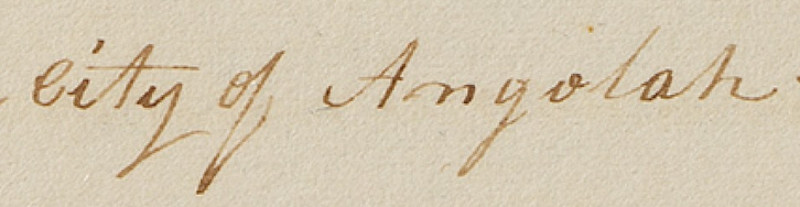
The Book of Mormon contains many unique names for places and people, and the spelling of these proper nouns is sometimes different in the 1830 edition. For example, the place name “Angola” in Mormon 2:4 is spelled “Angelah” in 1830, and “Angolah” in the printer’s manuscript. That page is missing from the original manuscript.
The name “Gadianton” is sometimes spelled with one “d” and sometimes with two. This spelling instability was present in the printer’s manuscript and ended up in the 1830 printing. Later printings settled on one “d.”

The word “Cumorah” also has unstable spelling in the printer’s manuscript. It is sometimes spelled as “Comorah” or “Camorah,” although “Cumorah is most common.” The 1830 edition uses “Camorah,” perhaps because the first occurrence of the word has that spelling. Here are all of the instances of the word in Mormon chapter 6. Note that the first one, spelled “Camorah,” was later scratched out and “Cumorah” was written above it.
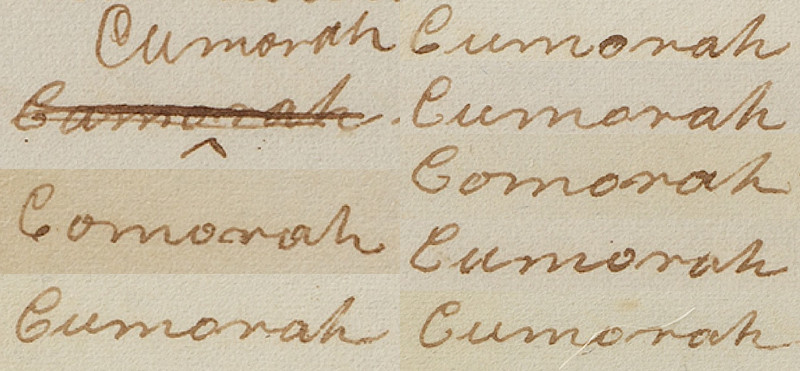
The following table lists spelling errors of proper nouns in the 1830 text, which were later changed to match the spelling in the original manuscript or printer’s manuscript.
| Reference | 1830 | Current |
|---|---|---|
| Mormon 4:20 | Beaz | Boaz |
| Mormon 6:14 | Joneam | Jeneum |
| Mormon 6:14 | Camenihah | Cumenihah |
| Ether 1:15 | Ammgaddah | Amnigaddah |
Printing Errors
Many of the differences between the 1830 edition and the current edition have been made to bring the text into conformity with the printer’s manuscript, or the original manuscript where it is available.
| Reference | Printer’s Manuscript | 1830 Printing |
|---|---|---|
| 1 Nephi 14:9 | “that great and abominable church, which is the mother of abominations, whose foundation is the devil” | “that great and abominable church, which is the mother of abominations, whose founder is the devil” |
| Jacob 2:6 | “Yea, it grieveth my soul and causeth me to shrink with shame before the presence of my Maker, that I must testify unto you concerning the wickedness of your hearts.” | “Yea, it grieveth my soul and causeth me to shrink with shame before the presence of my Maker, that I might testify unto you concerning the wickedness of your hearts.” |
| Jacob 7:25 | “Wherefore, the people of Nephi did fortify against them with their arms“ | “Wherefore, the people of Nephi did fortify against them with their armies“ |
| Mosiah 27:28 | “Nevertheless, after wadeing through much tribulation…” | “Nevertheless, after wandering through much tribulation…” |
| Alma 13:10 | “Now, as I said concerning the holy order, or this high priesthood …” | “Now, as I said concerning the holy order of this high priesthood …” |
| Alma 43:17 | “he was appointed Chief Commander over the armies of the Nephites” | “he was appointed Chief Captain over the armies of the Nephites” |
| Alma 57:25 | “… and also the foes of our whole army …” | “… and also the joy of our whole army …” |
| Helaman 3:23 | “Gadianton the nobler“ | “Gadianton the robber“ |
| Helaman 13:20 | “because they have set their hearts upon their riches, I will hide up their treasures” | “because they have set their hearts upon their riches, and will hide up their treasures” |
| 3 Nephi 20:19 | “I will make thy horn iron, and I will make thy hoops brass” | “I will make thy horn iron, and I will make thy hoofs brass” |
| 4 Nephi 1:7 | “insomuch that they did fill cities again where there had been cities burned” | “insomuch that they did build cities again where there had been cities burned” |
| Mormon 9:30 | “for I know that ye shall hear my words” | “for I know that ye shall have my words” |
| Ether 3:14 | “In me shall all mankind have light, and that eternally” | “In me shall all mankind have life, and that eternally” |
Many printing errors were simply omissions. These range from a single ampersand (&) to entire sentences. In the following table the omitted words are given in strikethrough:
| Reference | 1830 text |
|---|---|
| 1 Nephi 13:18 | “the wrath of God was upon |
| 1 Nephi 13:41 | “…and the words of the Lamb shall be made known in the records of thy seed, as well as in the records of the twelve apostles of the Lamb; wherefore they |
| Mosiah 12:26 | “I say unto |
| Mosiah 15:11 | “I say unto |
| Mosiah 23:20 | “…and they built a city, which they called |
| Alma 1:32 | “For those who did not belong to their Church, did indulge themselves in sorceries, and in idolatry or idleness, and in bablings, and in envyings and strife; wearing costly apparel; being lifted up in the pride of their own eyes; |
| Alma 11:20 | “Now it was for the sole purpose to get gain, because they received |
| Alma 32:30 | “But behold, as the seed swelleth, and sprouteth, and beginneth to grow, and then ye must needs say, That the seed is good; for behold it swelleth, and sprouteth, and beginneth to grow. |
| Alma 54:8 | “But as ye have |
| 3 Nephi 4:18-19 | “because of their much provision which they had laid up in store |
| Mormon 4:8 | “And when the Nephites saw that they had driven the Lamanites they did again boast of their |
Grammatical Changes
A lot of minor changes have been made to improve and modernize the language of the Book of Mormon. I only found two chapters in the 1830 edition which have no word changes in the current edition, but there are still changes to their punctuation. Not surprisingly, they are two of the shortest chapters in the book: 1 Nephi 9 and Moroni 5.
Who vs. Which or That
One common revision found in the current edition of the Book of Mormon is a pronoun usage transition to favor the word “who” in most places that reference a person. The 1830 edition, like the King James Bible, more often uses less specific pronouns like “which” or “that.” Mosiah 15:14 is a typical example:
| 1830: | And these are they which hath published peace, that hath brought good tidings of good, that hath published salvation; that saith unto Zion, Thy God reigneth!” |
| Current: | “And these are they who have published peace, who have brought good tidings of good, who have published salvation; and said unto Zion: Thy God reigneth!” |
Most of the boldfaced words in this verse have been changed to “who” in the current text, with the only exception being the last one which was changed to “and.” Also note that the word “hath” has been changed to “have,” and the word “saith” has been changed to “said.”
Here is another example, from Alma 6:8:
| 1830: | “… according to the testimony of Jesus Christ, the Son of God, which should come for to redeem his people from their sins, and the holy order by which he was called.” |
| Current: | “… according to the testimony of Jesus Christ, the Son of God, who should come to redeem his people from their sins, and the holy order by which he was called” |
Revisiting Verbs in the Book of Mormon
A few years ago I made a study of the verbs in the Book of Mormon. Little did I know at the time how much those verbs had been revised and edited over the years! One of the first things I noticed while reading the 1830 edition was how often the wrong verb tense was used. I say “wrong,” but I guess it might not have been exactly wrong in 1830 in rural America. Some of the grammar we use today will sound wrong to our great-grandchildren.
Alma 5:9 provides an illustrative example:
| 1830: | “And again I ask, was the bands of death broken, and the chains of hell which encircled them about, were they loosed?” |
| Current: | “And again I ask, were the bands of death broken, and the chains of hell which encircled them about, were they loosed?” |
This sentence contains two instances of the verb “to be,” and in the current edition the conjugation of both instances is the same: “were,” which is the preterite (or past tense) form of the verb used for plural subjects. Both subjects — “the bands of death” and “the chains of hell” — are plural. In the 1830 edition the first instance is incorrectly conjugated using the singular preterite “was” but the second instance is conjugated correctly.
Something like this happens on nearly every page in the 1830 printing. Sometimes the difference is an archaic verb tense, and sometimes it is an incorrect conjugation (and sometimes it is both). To give you a sense of just how frequent these are, the following table contains all of the verb changes I found in Alma chapter VIII, which is 6 pages long in the 1830 edition and comprises Alma chapters 10 and 11 in the current edition. (Verb changes are given in boldface type. Any other changes contained in the quotes are italicized.)
| Verse | 1830 Text |
|---|---|
| Alma 10:1 | “Now these are the words which Amulek preached unto the people which was in the land of Ammonihah …” |
| Alma 10:7 | “… for thou shalt feed a prophet of the Lord; yea, a holy man, which art a chosen man of God; for he hath fasted many days because of the sins of this people …” |
| Alma 10:10 | “… and this he hath done while this Alma hath dwelt at my house.” |
| Alma 10:12 | “… and also of the things which was to come …” |
| Alma 10:32 | “Now the object of these lawyers were to get gain …” |
| Alma 11:1 | “… every man which was a judge of the law, or those which was appointed to be judges …” |
| Alma 11:2 | “Now if a man oweth another, and he would not pay that which he did owe, he was complained of to the judge … and he judgeth the man according to the law and the evidences which are brought against him, and thus the man was compelled to pay that which he oweth …” |
| Alma 11:3 | “And the judge receiveth for his wages according to his time …” |
| Alma 11:20 | “… that they might get money according to the suits which was brought before them …” |
| Alma 11:21 | “… therefore, he saith unto Amulek …” |
| Alma 11:22 | “And Amulek saith unto him … And Zeezrom saith unto him: Behold, here is six onties of silver …” |
| Alma 11:23 | “Now Amulek saith …” |
| Alma 11:26 | “And Zeezrom saith unto him …” |
| Alma 11:39 | “… Yea, he is the very Eternal Father of heaven and of earth, and all things which in them is …” |
There are 3.3 verb changes per page in Alma chapter VIII. Assuming a similar rate of change for the rest of the book, we can estimate that there are about 2000 similar changes in the whole book.
Had Ought
The 1830 edition uses the curious phrase “had ought to be” (or “had not ought to be”) frequently. In the current edition the word “had” has been removed in all such places. Here is a typical example:
“And he had gone about among the people, preaching to them that which he termed to be the word of God, bearing down against the church; declaring unto the people that every priest and teacher had ought to become popular; and they ought not to labor with their own hands, but that they had ought to be supported by the people.” (Alma 1:3).
Notice that the 1830 text included the word “ought” three times in that verse, and two out of three times it was paired with the word “had.” In the current text the word “had” has been removed. Similar changes are made in 1 Nephi 15:3, 2 Nephi 25:27, Mosiah 2:18-19, Mosiah 4:21, Mosiah 8:13, Mosiah 12:30, Mosiah 15:26-27, Mosiah 16:13, Mosiah 29:34, Alma 9:30, Alma 23:3, Alma 29:3-4, Alma 33:2, Alma 36:29-30, Alma 60:10, Helaman 7:15, Helaman 9:22, 3 Nephi 23:1, 3 Nephi 27:27, and Moroni 8:24.
I found only six verses where the word “ought” was not paired with the word “had” in the 1830 edition, as in the middle instance in Alma 1:3 quoted above. The others are Jacob 2:34, Omni 1:2, Mosiah 29:36, Alma 16:18, and Alma 19:5. All of these are unchanged in the current printing.
I did some web searching to see whether “had ought” was a popular language construction in the early 19th century, but all I found was some old country song called “A Cowboy Had Ought To Be Single” (which I would love to hear, but I couldn’t find a recording of it), and a blog post with samples of Appalachian dialects.
Other Archaic Constructions
The 1830 edition often includes the shorthand “&c” — meaning “et cetera” — at the end of a list, and these instances have all been either removed or revised in the current printing. Here are a couple of representative examples, chosen at random from dozens of instances, given as they read in the 1830 edition:
“Therefore, if it were possible that Amlici should gain the voice of the people, he being a wicked man, would deprive them of their rights and privileges of the church, &c: for it was his intent to destroy the church of God” (Alma 2:4).
“Now the heads of the Lamanites were shorn; and they were naked, save it were skin, which was girded about their loins, and also their armour, which was girded about them, and their bows, and their arrows, and their stones, and their slings, &c” (Alma 3:5).
The phrase “go to it” appears in the 1830 printing a couple of times, but has been revised in different ways in different passages:
“And it came to pass that the servants did go
to itand labor with their mights” (Jacob 5:72)“…wherefore, go to
it, thy faith hath made thee whole” (Enos 1:8).
Sometimes the word “for” appears immediately before an infinitive verb, as in these passages:
“… according to the testimony of Jesus Christ, the Son of God, which should come for to redeem his people from their sins …” (Alma 6:8).
“And now behold, I say unto you that if it had been possible for Adam for to have partaken of the fruit of the tree of life at that time, there would have been no death …” (Alma 12:23).
“For behold, angels are declaring it unto many at this time in our land; and this is for the purpose of preparing the hearts of the children of men for to receive his word at the time of his coming in his glory” (Alma 13:24).
This construction was common in middle English, and may represent to influence of King James language on Joseph Smith. For to infinitives are still found in certain dialects, but are less common in American English.
Another archaic construction found occasionally in the 1830 printing is the indefinite article + present participle combination, as in the following examples:
“As I was a journeying to see a very near kindred, behold an angel of the Lord appeared unto me …” (Alma 10:7).
“… the foundation of the destruction of this people is a beginning to be laid by the unrighteousness of your lawyers and your judges” (Alma 10:27).
“… he departed out of the synagogue, and came over to a village which was called Ani-Anti, and there he found Muloki a preaching the word unto them” (Alma 21:11).
In all places where this construction is found the indefinite article (“a”) has been removed in the current text.
Bible Verse Quotes
These verses from the Lord’s sermon at the temple in Bountiful have an interesting grammatical revision:
“Or how wilt thou say to thy brother, Let me pull
outthe mote out of thine eye; and behold, a beam is in thine own eye? Thou hypocrite, first castoutthe beam out of thine own eye; and then shalt thou see clearly to castoutthe mote out of thy brother’s eye” (3 Nephi 14:4-5).
The 1830 text follows exactly the wording from the Sermon on the Mount in the King James Bible, but in later printings of the Book of Mormon the redundant preposition “out” has been removed from three similar phrases. I prefer the flow of the language in the current edition.

Another interesting Biblical quote is from the ten commandments, as taught by Abinadi to King Noah and his priests in Mosiah 13:12:
| 1830: | “Thou shalt not make unto thee any graven image, or any likeness of things which is in heaven above, or which is in the earth beneath, or which is in the water under the earth.” |
| Current: | “Thou shalt not make unto thee any graven image, or any likeness of things which are in heaven above, or which are in the earth beneath, or which are in the water under the earth.” |
| KJV (Exodus 20:4): | “Thou shalt not make unto thee any graven image, or any likeness of any thing that is in heaven above, or that is in the earth beneath, or that is in the water under the earth” |
And It Came to Pass
Mark Twain was famously unimpressed by the Book of Mormon. One of his complaints was the frequent repetition of the phrase “And it came to pass.” In his scathing review of the book Twain quipped that “If he [Joseph Smith] had left that out, his Bible would have been only a pamphlet.” Mark Twain was a gifted writer, and he may have had a valid point about writing style. Obviously I disagree with him about the overall value of the Book of Mormon.
But imagine my surprise when I found that the phrase “And it came to pass” actually appears more times in the 1830 edition than it does in the current edition! The phrase has been removed from the text at least 43 times by my count. I noticed this on the very first page that I started listening to the audiobook recordings in the Gospel Library app while following along in the 1830 text. (Scanning back and forth between two books was not very efficient, so this sped up the workflow.) On the next 6 pages of the book the phrase was removed 7 times:
“
And it came to pass that itwas done before the chief judge of the land” (Alma 14:4).“And
it came to pass thathe began to plead for them from that time forth; but they reviled him, saying: Art thou also possessed with the devil? Andit came to pass thatthey spit upon him, and cast him out from among them …” (Alma 14:7)“And
it came to pass thatwhen Amulek saw the pains of the women and children who were consuming in the fire, he also was pained …” (Alma 14:10).“And
it came to pass thatwhen they had been cast into prison three days …” (Alma 14:18).“And
it came to pass thatwhen Alma had said these words, Zeezrom leaped upon his feet …” (Alma 15:11).“And
it came to pass thatthe Lamanites did not come again to war against the Nephites until the fourteenth year …” (Alma 16:12).
The phrase is also removed from 1 Nephi 10:17, 2 Nephi 4:10, Mosiah 22:10, Mosiah 23:3, Mosiah 23:5, Mosiah 23:6, Mosiah 23:34, Mosiah 23:37, Mosiah 24:11, Mosiah 24:12, Mosiah 24:20, Mosiah 24:25, Mosiah 25:15, Mosiah 28:6, Alma 8:5, Alma 8:18, Alma 8:19, Alma 8:27, Alma 8:31, Alma 10:31, Alma 13:31, Alma 17:26, Alma 20:2, Alma 20:28, Alma 22:25, Alma 27:20, Alma 27:26, Alma 30:21, Alma 43:35, Alma 55:8, Helaman 2:8, 3 Nephi 7:23, 3 Nephi 11:16, 3 Nephi 19:30.
Special notice should be given to Alma 43:41-42, where the narrative is simplified in addition to removing “and it came to pass” twice:
“And it came to pass that Moroni and his army met the Lamanites in the valley, on the other side of the river Sidon
. —Andit came to pass that Moroni and his armybegan to fall upon them, and to slay them. Andit came to pass thatthe Lamanites did flee again before them, towards the land of Manti; and they were met again by the armies of Moroni.”
In the printer’s manuscript, where Joseph Smith continued to make textual edits for subsequent printings of the Book of Mormon, these phrases are scratched out in a heavy pen.

A Sampler of Grammatical Revisions
Joseph Smith never finished elementary school. The following quotations from the 1830 edition clearly illustrate the limitations of his language at the time he translated the Book of Mormon:
“… for thus is the covenants of the Lord with our fathers” (1 Nephi 22:6).
“And now, my brethren, I have spoken plain that ye cannot err” (2 Nephi 25:20).
“… there is no works of darkness save it shall be made manifest in the light” (2 Nephi 30:17).
“And it came to pass that the servant of the Lord of the vineyard, done according to the word of the Lord of the vineyard …” (Jacob 5:10)
“… and this he done that he might subject them to him” (Alma 2:10).
“… they did lay down the weapons of their rebellion, that they did not fight against God no more” (Alma 23:7).
“… Now this he done that he might preserve their hatred towards the Nephites, … this he done that he might usurp great power over them …” (Alma 43:7-8).
“Behold, here is our weapons of war …” (Alma 44:8).
“And all these gifts comes by the Spirit of Christ” (Moroni 10:17).
There is a long list of sentences in the 1830 edition (including all of those just quoted) that appear to have been revised to improve their readability, brevity, or grammar. The following table is not an attempt at a comprehensive listing, just a collection of revisions that I thought were interesting. Most of these changes appear to have been made by Joseph Smith for the 1837 edition, so we can see how much he had learned in those intervening years from the School of the Prophets and other educational activities.
| Verse | Edition | Text |
|---|---|---|
| 1 Nephi 2:6 | 1830: | “… he pitched his tent in a valley beside a river of water.” |
| Current: | “… he pitched his tent in a valley by the side of a river of water.” | |
| 1 Nephi 8:7 | 1830: | “And it came to pass that as I followed him, and after I had followed him, I beheld myself that I was in a dark and dreary waste.” |
| Current: | “And it came to pass that as I followed him I beheld myself that I was in a dark and dreary waste” | |
| 1 Nephi 8:12 | 1830: | “… for I knew that it was desirous above all other fruit.” |
| Current: | “… for I knew that it was desirable above all other fruit” | |
| 1 Nephi 8:37 | 1830: | “And he did exhort them then with all the feeling of a tender parent, that they would hearken to his words, in that, perhaps the Lord would be merciful to them …” |
| Current: | “And he did exhort them then with all the feeling of a tender parent, that they would hearken to his words, that perhaps the Lord would be merciful to them” | |
| 1 Nephi 10:3 | 1830: | “How that after they were destroyed, yea even that great city Jerusalem, and that many were carried away captive into Babylon, that according to the own due time of the Lord, they should return again, yea, even be brought back out of captivity; and after they are brought back out of captivity, to possess again the land of their inheritance.” |
| Current: | “That after they should be destroyed, even that great city Jerusalem, and many be carried away captive into Babylon, according to the own due time of the Lord, they should return again, yea, even be brought back out of captivity; and after they should be brought back out of captivity they should possess again the land of their inheritance” | |
| 1 Nephi 13:26 | 1830: | “And after that they go forth by the hand of the twelve apostles of the Lamb, from the Jews unto the Gentiles; behold, after this, thou seest the formation of that great and abominable church …” |
| Current: | “And after they go forth by the hand of the twelve apostles of the Lamb, from the Jews unto the Gentiles, thou seest the formation of that great and abominable church” | |
| 1 Nephi 13:34 | 1830: | “… because of the most plain and precious parts of the gospel of the Lamb which hath been kept back by that abominable church, which is the mother of harlots, saith the Lamb; wherefore, I will be merciful unto the Gentiles in that day, saith the Lamb, insomuch that I will bring forth unto them in mine own power, much of my gospel …” |
| Current: | “… because of the most plain and precious parts of the gospel of the Lamb which have been kept back by that abominable church, which is the mother of harlots, saith the Lamb—I will be merciful unto the Gentiles in that day, insomuch that I will bring forth unto them, in mine own power, much of my gospel” | |
| 1 Nephi 13:37 | 1830: | “… yea, whoso shall publish peace, that shall publish tidings of great joy, how beautiful upon the mountains shall they be.” |
| Current: | “… and whoso shall publish peace, yea, tidings of great joy, how beautiful upon the mountains shall they be” | |
| 1 Nephi 14:1-2 | 1830: | “And it shall come to pass, that if the Gentiles shall hearken unto the Lamb of God in that day that he shall manifest himself unto them in word, and also in power, in very deed, unto the taking away of their stumbling blocks, if it so be that they harden not their hearts against the Lamb; and if it so be that they harden not their hearts against the Lamb of God, they shall be numbered among the seed of thy father” |
| Current: | “And it shall come to pass, that if the Gentiles shall hearken unto the Lamb of God in that day that he shall manifest himself unto them in word, and also in power, in very deed, unto the taking away of their stumbling blocks—And harden not their hearts against the Lamb of God, they shall be numbered among the seed of thy father” | |
| 1 Nephi 15:13 | 1830: | “many generations, after that the Messiah hath manifested himself in body” |
| Current: | “many generations after the Messiah shall be manifested in body” | |
| 1 Nephi 17:46 | 1830: | “… ye know that by his word he can cause that rough places be made smooth” |
| Current: | “… ye know that by his word he can cause the rough places to be made smooth” | |
| 1 Nephi 18:13 | 1830: | “… nevertheless they did loose me not.” |
| Current: | “… nevertheless they did not loose me.” | |
| 1 Nephi 18:23 | 1830: | “… we did arrive to the promised land” |
| Current: | “… we did arrive at the promised land” | |
| 1 Nephi 19:13 | 1830: | “And as for they which are at Jerusalem, saith the prophet, shall be scourged by all people, saith the prophet, because they crucify the God of Israel” |
| Current: | “And as for those who are at Jerusalem, saith the prophet, they shall be scourged by all people, because they crucify the God of Israel” | |
| 1 Nephi 22:1 | 1830: | “And now it came to pass that after I, Nephi, after that I had read these things which were engraven upon the plates of brass …” |
| Current: | “And now it came to pass that after I, Nephi, had read these things which were engraven upon the plates of brass …” | |
| 1 Nephi 22:23 | 1830: | “yea, in fine, all they which belong to the kingdom of the devil it is they which need fear, and tremble, and quake; it is they which must be brought low in the dust; it is they which must be consumed as stubble” |
| Current: | “yea, in fine, all those who belong to the kingdom of the devil are they who need fear, and tremble, and quake; they are those who must be brought low in the dust; they are those who must be consumed as stubble” | |
| 2 Nephi 1:17 | 1830: | “… for I have feared, lest for the hardness of your hearts, lest the Lord your God should come out in the fulness of his wrath, upon you …” |
| Current: | “… for I have feared, lest for the hardness of your hearts the Lord your God should come out in the fulness of his wrath upon you …” | |
| 2 Nephi 1:22 | 1830: | “And all things which were created, must have remained in the same state which they were, after they were created” |
| Current: | “And all things which were created must have remained in the same state in which they were after they were created” | |
| 2 Nephi 4:5 | 1830: | “… I know that if ye are brought up in the right way that ye should go ye will not depart from it.” |
| Current: | “…I know that if ye are brought up in the way ye should go ye will not depart from it.” | |
| 2 Nephi 4:12 | 1830: | “And it came to pass that after Lehi, had spake unto all his household …” |
| Current: | “And it came to pass after my father, Lehi, had spoken unto all his household…” | |
| 2 Nephi 4:24 | 1830: | “… yea, my voice have I sent upon high …” |
| Current: | “… yea, my voice have I sent up on high …” | |
| 2 Nephi 5:3 | 1830: | “For behold, we will not that he shall be our ruler” |
| Current: | “For behold, we will not have him to be our ruler” | |
| 2 Nephi 5:15,17 | 1830: | “And I did teach my people, that they should build buildings, and that they should work in all manner of wood … “And it came to pass that I, Nephi, did cause my people that they should be industrious, and that they should labor with their hands” |
| Current: | “And I did teach my people to build buildings, and to work in all manner of wood … “And it came to pass that I, Nephi, did cause my people to be industrious, and to labor with their hands.” | |
| 2 Nephi 9:29 | 1830: | “But to be learned is good if it so be that they hearken unto the counsels of God.” |
| Current: | “But to be learned is good if they hearken unto the counsels of God.” | |
| 2 Nephi 16:5 | 1830: | “Then said I, Wo me! for I am undone; because I a man of unclean lips …” |
| Current: | “Then said I: Wo is unto me! for I am undone; because I am a man of unclean lips …” | |
| 2 Nephi 16:2 | 1830: | “Then I said, Here I; send me.” |
| Current: | “Then I said: Here am I; send me.” | |
| 2 Nephi 33:9 | 1830: | “But behold, for none of these I cannot hope except they shall be reconciled unto Christ” |
| Current: | “But behold, for none of these can I hope except they shall be reconciled unto Christ” | |
| Enos 1:3 | 1830: | “Behold, I went to hunt beasts in the forest; and the words which I had often heard my father speak concerning eternal life, and the joy of the saints, and the words of my father, sunk deep into my heart.” |
| Current: | “Behold, I went to hunt beasts in the forests; and the words which I had often heard my father speak concerning eternal life, and the joy of the saints, sunk deep into my heart.” | |
| Mosiah 2:13 | 1830: | “Neither have I suffered that ye should be confined in dungeons, nor that ye should make slaves one of another, or that ye should murder, or plunder, or steal, or commit adultery; or even I have not suffered that ye should commit any manner of wickedness …” |
| Current: | “Neither have I suffered that ye should be confined in dungeons, nor that ye should make slaves one of another, nor that ye should murder, or plunder, or steal, or commit adultery; nor even have I suffered that ye should commit any manner of wickedness …” | |
| Mosiah 3:19 | 1830: | “For the natural man is an enemy to God, and has been from the fall of Adam, and will be, forever and ever; but if he yieldeth to the enticings of the Holy Spirit, and putteth off the natural man and becometh a saint through the atonement of Christ the Lord, and becometh as a child, submissive, meek, humble, patient, full of love, willing to submit to all things which the Lord seeth fit to inflict upon him, even as a child doth submit to his father.” |
| Current: | “For the natural man is an enemy to God, and has been from the fall of Adam, and will be, forever and ever, unless he yields to the enticings of the Holy Spirit, and putteth off the natural man and becometh a saint through the atonement of Christ the Lord, and becometh as a child, submissive, meek, humble, patient, full of love, willing to submit to all things which the Lord seeth fit to inflict upon him, even as a child doth submit to his father.” | |
| Mosiah 4:22 | 1830: | “… and yet ye put up no petition, or repenteth not of the thing which thou hast done.” |
| Current: | “… and yet ye put up no petition, nor repent of the thing which thou hast done.” | |
| Mosiah 22:13-14 | 1830: | “And after being many days in the wilderness, they arrived in the land of Zarahemla, and joined his people, and became his subjects. And it came to pass that Mosiah received them with joy” |
| Current: | “And after being many days in the wilderness they arrived in the land of Zarahemla, and joined Mosiah’s people, and became his subjects. And it came to pass that Mosiah received them with joy” | |
| Alma 5:25 | 1830: | “I say unto you, nay, except ye make our Creator a liar from the beginning, or suppose that he is a liar from the beginning; or also, ye cannot suppose that such an one can have place in the kingdom of heaven …” |
| Current: | “I say unto you, Nay; except ye make our Creator a liar from the beginning, or suppose that he is a liar from the beginning, ye cannot suppose that such can have place in the kingdom of heaven …” | |
| Alma 5:45 | 1830: | “Do ye suppose that I know not of these things myself?” |
| Current: | “Do ye not suppose that I know of these things myself?” | |
| Alma 17:3 | 1830: | “… and when they taught, they taught with power and authority, even as with the power and authority of God” |
| Current: | “… and when they taught, they taught with power and authority of God” | |
| Alma 17:34 | 1830: | “… and he went forth and stood to contend with those who stood by the waters of Sebus; and they were not in number a very few.” |
| Current: | “and he went forth and stood to contend with those who stood by the waters of Sebus; and they were in number not a few” | |
| Alma 31:35 | 1830: | “Behold, O Lord, their souls are precious, and many of them are our near brethren” |
| Current: | “Behold, O Lord, their souls are precious, and many of them are our brethren” | |
| Alma 39:11 | 1830: | “… suffer not that the devil lead away your heart again after those wicked harlots.” |
| Current: | “…suffer not the devil to lead away your heart again after those wicked harlots” | |
| Alma 43:25 | 1830: | “Now Moroni, leaving a part of his army in the land of Jershon, lest by any means a part of the Lamanites should come into that land and take possession of the city ; and Moroni took the remainder part of his army and marched over into the land of Manti.” |
| Current: | “Now Moroni, leaving a part of his army in the land of Jershon, lest by any means a part of the Lamanites should come into that land and take possession of the city, took the remaining part of his army and marched over into the land of Manti” | |
| Alma 55:31 | 1830: | “… yea, they would not partake of their wine; |
| Current: | “… yea, they would not partake of their wine, save they had first given to some of the Lamanite prisoners” | |
| Alma 58:16 | 1830: | “I caused that Gid, with a small number of men, should secrete himself in the wilderness, and also that Teomner should, with a small number of men, secrete themselves also in the wilderness.” |
| Current: | “I caused that Gid, with a small number of men, should secrete himself in the wilderness, and also that Teomner and a small number of men should secrete themselves also in the wilderness” | |
| Alma 60:17 | 1830: | “But behold, now the Lamanites are coming upon us, and they are murdering our people with the sword; yea, our women and our children; taking possession of our lands, and also carrying them away captive, causing them that they should suffer all manner of afflictions …” |
| Current: | “But behold, now the Lamanites are coming upon us, taking possession of our lands, and they are murdering our people with the sword, yea, our women and our children, and also carrying them away captive, causing them that they should suffer all manner of afflictions” | |
| Helaman 1:16 | 1830: | “Therefore, the king of the Lamanites, whose name was Tubaloth, who was the son of Ammoron. Now Tubaloth supposing that Coriantumr, he being a mighty man, could stand against the Nephites, insomuch with his strength and also with his great wisdom, that by sending him forth he should gain power over the Nephites” |
| Current: | “Therefore, the king of the Lamanites, whose name was Tubaloth, who was the son of Ammoron, supposing that Coriantumr, being a mighty man, could stand against the Nephites, with his strength and also with his great wisdom, insomuch that by sending him forth he should gain power over the Nephites” | |
| Helaman 9:22 | 1830: | “O ye ought to begin to howl and mourn, because of the great destruction at this time which doth await you, except ye shall repent.” |
| Current: | “O ye ought to begin to howl and mourn, because of the great destruction which at this time doth await you, except ye shall repent” | |
| 3 Nephi 3:15 | 1830: | “As the Lord liveth, except ye repent of all your iniquities, and cry unto the Lord, that they would in nowise be delivered out of the hands of those Gadianton robbers.” |
| Current: | “As the Lord liveth, except ye repent of all your iniquities, and cry unto the Lord, ye will in nowise be delivered out of the hands of those Gadianton robbers” | |
| 3 Nephi 7:7 | 1830: | “And they did cause a great contention in the land, insomuch that the more righteous part of the people, although they were nearly all become wicked; yea, there were but few righteous men among them.” |
| Current: | “And they did cause a great contention in the land, insomuch that the more righteous part of the people had nearly all become wicked; yea, there were but few righteous men among them” | |
| 3 Nephi 10:4 | 1830: | “O ye people of these great cities which have fallen, which are a descendant of Jacob, yea, which are of the house of Israel |
| Current: | “O ye people of these great cities which have fallen, who are descendants of Jacob, yea, who are of the house of Israel, how oft have I gathered you as a hen gathereth her chickens under her wings, and have nourished you.” | |
| 3 Nephi 19:14 | 1830: | “And behold, they were encircled about as if it were fire …” |
| Current: | “And behold, they were encircled about as if it were by fire …” | |
| 3 Nephi 29:7 | 1830: | “Yea, and wo unto him that shall say at that day, that there can be no miracle wrought by Jesus Christ, for to get gain …” |
| Current: | “Yea, and wo unto him that shall say at that day, to get gain, that there can be no miracle wrought by Jesus Christ …” | |
| Mormon 4:14 | 1830: | “… and did take many prisoners of women and of children, and did offer them up as sacrifices unto their idol gods.” |
| Current: | “… and did take many prisoners both women and children, and did offer them up as sacrifices unto their idol gods” | |
| Mormon 8:3 | 1830: | “And my father also was killed by them; and I, even I remaineth alone to write the sad tale of the destruction of my people.” |
| Current: | “And my father also was killed by them, and I even remain alone to write the sad tale of the destruction of my people” | |
| Mormon 8:28 | 1830: | “Yea, it shall come in a day when the power of God shall be denied, and churches become defiled, and shall be lifted up in the pride of their hearts; yea, even in a day when leaders of churches and teachers, in the pride of their hearts, even to the envying of them who belong to their churches.” |
| Current: | “Yea, it shall come in a day when the power of God shall be denied, and churches become defiled and be lifted up in the pride of their hearts; yea, even in a day when leaders of churches and teachers shall rise in the pride of their hearts, even to the envying of them who belong to their churches” | |
| Ether 3:9 | 1830: | “… and never has man come before me with such exceeding faith as thou hast; for were it so ye could not have seen my finger.” |
| Current: | “… and never has man come before me with such exceeding faith as thou hast; for were it not so ye could not have seen my finger.” | |
| Ether 10:32 | 1830: | “… and they fought for the space of many years, in which Com gained power over Amgid” |
| Current: | “… and they fought for the space of many years, during which time Com gained power over Amgid” | |
| Moroni 9:1 | 1830: | “My beloved son, I write unto you again, that ye may know that I am yet alive; but I write somewhat that which is grievous.” |
| Current: | “My beloved son, I write unto you again that ye may know that I am yet alive; but I write somewhat of that which is grievous” |
The revision in each case means essentially the same thing as the original text, but the language is clearer in the current edition. Often the change is simply moving a word or phrase from one place to another.
More Substantial Changes
This section will consider passages that have been revised in a way that alters the meaning of the text. This is not an exhaustive list, but these are the passages that caught my attention.
Each text will be quoted as it appears in the 1830 edition, with words that were subsequently changed given in boldface. I will also include an image from the printer’s manuscript.
In My Dream
“… for behold, methought I saw (in my dream), a dark and dreary wilderness” (1 Nephi 8:4).
The phrase “in my dream” was added in a later printing, and you can see the additional phrase handwritten in the printer’s manuscript. Adding this phrase makes it clearer that Lehi is starting to tell his family what happened in his vision.

(Son of) the Eternal Father
“Behold the Lamb of God, yea, even the (Son of the) Eternal Father!” (1 Nephi 11:21).
“And I looked and beheld the Lamb of God, that he was taken by the people; yea, the (Son of the) Everlasting God was judged of the world” (1 Nephi 11:32).
“… and shall make known to all kindreds, tongues, and people, that the Lamb of God is the (Son of the) Eternal Father and the Savior of the world” (1 Nephi 13:40).
Later printings changed these phrases to “the Son of the Eternal Father” and “the Son of the everlasting God,” respectively. The scriptures are not always clear about which member of the Godhead is being referred to in a given passage, and often use the same terms to refer to God the Father and God the Son (see Isaiah 9:6 and Mosiah 15:1-5, for example). The Christian doctrine of the Trinity is a result of the confusion produced by passages like these. Revisions to these verses from Nephi’s vision clarify the teachings in at least these passages.


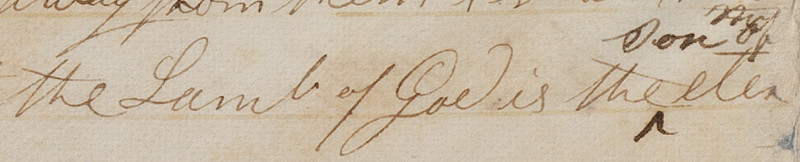
Mosiah, who is the Lamb of God
“… even the word of the justice of the Eternal God, and Jesus Christ, which is the Lamb of God …” (1 Nephi 12:18).
This one is interesting. The original manuscript and the printer’s manuscript both said “Jesus Christ,” but you can see that this was scratched out on the printer’s manuscript, and “Mosiah” was written above it. I presume that he meant to write “Messiah,” and just misspelled it, because obviously Mosiah is not the Lamb of God. The current printing says “Messiah.”

Awful Woundedness
“Neither will the Lord God suffer that the Gentiles shall forever remain in that state of awful woundedness, which thou beholdest they are in, because of the plain and most precious parts of the gospel of the Lamb which have been kept back by that abominable church, whose formation thou hast seen” (1 Nephi 13:32).
In the current edition the boldfaced phrase reads “awful state of blindness.” I am not a handwriting expert (says the doctor! Haha!), and you can judge for yourself in the image below, but the “state of” written above the word “awful” appears to be in the same handwriting with the same pen as the rest of the text, but the word “blindness” is different. I suspect “blindness” was written by Joseph Smith.

I Should Have Perished Also
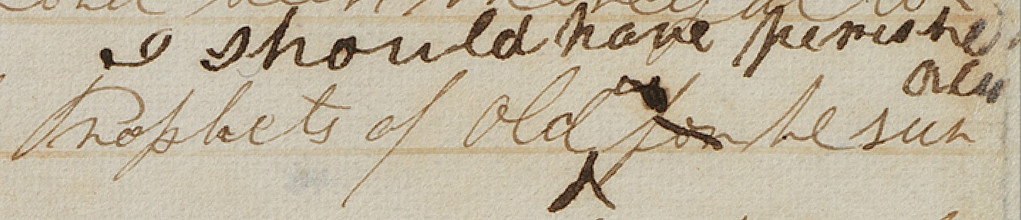
“… for had not the Lord been merciful, to show unto me concerning them, even as he had prophets of old, (I should have perished also) for he surely did show unto the prophets of old all things concerning them; and also he did show unto many concerning us; wherefore, it must needs be that we know concerning them for they are written upon the plates of brass” (1 Nephi 19:20-21).
The phrase, “I should have perished also” was added to the printer’s manuscript, apparently after the 1830 printing. It is not found in the original manuscript, and instead there is a run-on sentence that never completes the thought. Both Lehi and Jacob received knowledge through revelation that Jerusalem had been destroyed. The added phrase fixes the grammar, and the statement is accurate to what Nephi would have known at the time of his writing later in his ministry.
The Waters of Baptism
“Hearken and hear this, O house of Jacob, which are called by the name of Israel, and are come forth out of the waters of Judah, (or out of the waters of baptism), which swear by the name of the Lord, and make mention of the God of Israel, yet they swear not in truth nor in righteousness” (1 Nephi 20:1).
The phrase “or out of the waters of baptism” was not present in the original manuscript, printer’s manuscript, or 1830 printing, but was added to the text later. According to a note at the Joseph Smith Papers it was added for the 1840 printing.
This verse is a quote from Isaiah 48:1, and the phrase in question does not appear in the Bible or in the Joseph Smith Translation of the Bible. The 1830 Book of Mormon largely mirrors the King James text, with some minor phrasing change at the end.

Constrained or Restrained
In the 1830 printing the word “constrain” is used where later editions use the word “restrain.” Here are three examples:
” … and that which ye call anger, was the truth, according to that which is in God, which he could not constrain, manifesting boldly concerning your iniquities” (2 Nephi 1:26).
“… wherefore Ether came forth in the days of Coriantumr, and began to prophesy unto the people, for he could not be constrained because of the Spirit of the Lord which was in him” (Ether 12:2).
“… all the people upon the face of the land were shedding blood, and there was none to constrain them” (Ether 13:31).
These two words have a similar meaning, and I think either word could be used here. Several online dictionaries suggested that “restrain” is the more precise verb for this particular meaning.

Might or May
“And the Messiah cometh in the fulness of time, that he might redeem the children of men from the fall” (2 Nephi 2:26).
In later printings the word “might” was changed to “may”. This change was made on the printer’s manuscript, as you can see in the image below.

Whose Loins?
“Wherefore, the fruit of my loins shall write; and the fruit of the loins of Judah shall write; and that which shall be written by the fruit of thy loins, and also that which shall be written by the fruit of the loins of Judah, shall grow together, unto the confounding of false doctrines and laying down of contentions …” (2 Nephi 3:12).
This passage is a prophecy recorded by Joseph the son of Israel, in the voice of the Lord. It is about the Book of Mormon, which was written by descendants of Joseph, and the Bible, which was written largely by descendants of Judah. It is clear from the rest of the verse that the first instance that says “my loins” should say “thy loins.” The original manuscript page is missing for this verse, so we don’t know whether this was a transcription error, but that seems likely.

A Light Thing of the People
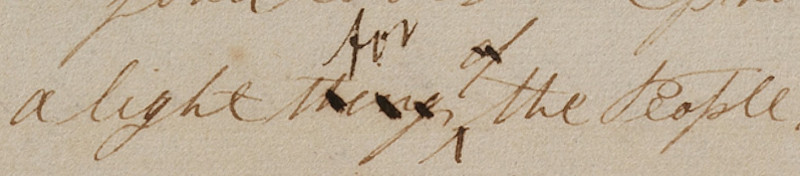
“… for a law shall proceed from me, and I will make my judgment to rest for a light thing of the people” (2 Nephi 8:4).
In the current edition the words “thing of” have been replaced with the word “for.” This change is marked on the printer’s manuscript, where it also appears that the word “of” was added, perhaps as part of the transcription process. See the image below. Also of some interest is the comparison verse from Isaiah 51:4 in the King James Bible, which reads “light of the people.” This change makes a significant change to the meaning of the verse, especially from the 1830 printing but also somewhat from the King James text.
He that hath Cut Rahab
“Art thou not it that hath cut Rahab, and wounded the dragon? Art thou not it which hath dried the sea …” (2 Nephi 8:9-10).
The 1830 edition text reads exactly as the equivalent verses from Isaiah 51:9-10, but in the current edition the word “it” has been changed to “he,” and the word “which” has been changed to “who.” Interestingly, the first “it” is changed on the printer’s manuscript, but the second one was left in place.

Which I Said to Thy Soul
“But I will put it into the hand of them that afflict thee; which I said to thy soul: Bow down, that we may go over” (2 Nephi 8:23).
Later editions change the words “which I” to “who have,” which significantly changes the meaning of the verse and aligns it with the original verse from Isaiah 51:23 that Jacob was quoting. This page is missing from the original manuscript, so it is not clear whether this was a transcription error.

White and Delightsome
“And then shall they rejoice; for they shall know that it is a blessing unto them from the hand of God; and their scales of darkness shall begin to fall from their eyes; and many generations shall not pass away among them, save they shall be a white and a delightsome people” (2 Nephi 30:6).
In this passage Nephi is prophesying of a future day when his own wayward descendants, and those of his brothers, will learn the gospel of Jesus Christ and be blessed by following him. Dark skin color was used as a symbol for wickedness and separation from God in the early part of the Book of Mormon, so it makes sense that Nephi would use this term. In the current edition the word “white” has been changed to “pure,” which doesn’t have so much racial connotation.

Things Which I Have Written
“And the things which I have written in weakness, will be made strong unto them: for it persuadeth them to do good; it maketh known unto them of their fathers; and it speaketh of Jesus, and persuadeth men to believe in him, and to endure to the end, which is life eternal” (2 Nephi 33:4).
This verse contains two textual changes which were made by Joseph Smith for the 1837 printing. One of these changes was made on the printer’s manuscript, as pictured below. The word “things” was changed to “words” and the word “men” was changed to “them.”
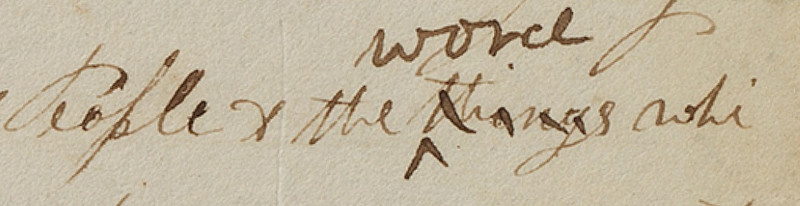
Never Before Heard Nor Seen
“Because of thy faith in Christ, whom thou hast not heard nor seen” (Enos 1:8).
In a later printing the word “not” was changed to “never before.” The original phrasing could be misinterpreted or misunderstood as meaning that Enos was somehow not hearing the word of the Lord while receiving a revelation from him. The updated phrasing was written in the printer’s manuscript, as you can see below.

Benjamin or Mosiah
“And now Limhi was again filled with joy on learning from the mouth of Ammon that king Benjamin had a gift from God, whereby he could interpret such engravings; yea, and Ammon also did rejoice” (Mosiah 21:28).
Actually, it was king Mosiah. Benjamin died in chapter 6, before Ammon met king Limhi. The printer’s manuscript says “Benjamin,” and is not scratched out. I wonder if Mormon simply got this wrong while abridging the history.

Interestingly, this particular name substitution also happens in the writings of Moroni, in a discussion about the translation of the same records. I guess it was hard to keep those ancient prophet-kings straight while writing and commenting on the history.
“… and they were forbidden to come unto the children of men until after that he should be lifted up upon the cross; and for this cause did king Benjamin keep them, that they should not come unto the world until after Christ should show himself unto his people” (Ether 4:1).

My Soul was Wrecked
“… My soul was wrecked with eternal torment; but I am snatched, and my soul is pained no more” (Mosiah 27:29).
This is Alma the younger describing his miraculous repentance, with the stark contrast between his miserable state before and his blessed state after. In the current printing the word “wrecked” has been changed to “racked.” A rack is an ancient instrument of torture, on which the victim’s body is stretched. The guilt of unrepented sin is torture indeed. Old sayings that have been unmoored from their original meaning often experience drift over time, and it is possible that a young Joseph Smith used the wrong word the first time around and decided to fix the error later.
Interestingly, a parallel passage in Alma 36:12-17 uses the word “racked” and not “wrecked” in four places, suggesting that perhaps the word “wrecked” in the passage above was an error made by the scribe.

How to Suffer His People
“And he will take upon him death, that he may loose the bands of death which bind his people; and he will take upon him their infirmities, that his bowels may be filled with mercy, according to the flesh, that he may know according to the flesh how to suffer his people according to their infirmities” (Alma 7:12).
The current edition changes “suffer” to “succor,” which makes more sense. The scriptures declare that the Lord is long-suffering, but this verse is teaching about his power to help us, not about his power to tolerate us.

Son of the Only Begotten of the Father
“Thus they become high priests forever, after the order of the Son of the Only Begotten of the Father …” (Alma 13:9).
Jesus is the Son of the Father and the Only Begotten of the Father, but who is the “son of the only begotten of the father”? This is obviously an error, but because this page of the original manuscript was destroyed we can’t trace where the error occurred. The word “of” has been scratched out on the printer’s manuscript, and in current printings a comma follows the word “Son.”

Arrest Them
“Behold, the Scriptures are before you; if ye will arrest them, it shall be to your own destruction” (Alma 13:20).
Arrest is obviously the wrong word here. On the printer’s manuscript is has been scratched out and replaced with “wrest,” which is a verb that means to grab something by twisting or forceful movements. Again the original manuscript page has been destroyed, but it seems possible that this was a transcription or dictation error.
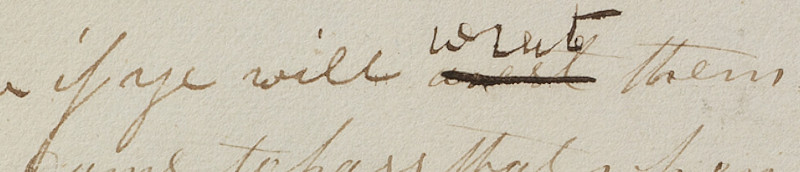
Whether or Whither
“… now Zoram and his two sons, knowing that Alma was high priest over the church, and having heard that he had the spirit of prophecy, therefore they went unto him and desired of him to know whether the Lord would that they should go into the wilderness in search of their brethren, who had been taken captive by the Lamanites” (Alma 16:5).
The current edition changes “whether” to “whither,” which changes the question asked of Alma from, “Should we go and try to find our kidnapped countrymen?” to “Where should we go to find them?” In the printer’s manuscript of the Book of Mormon the original writing reads “whether,” but the “e” is turned into an “i” by a revision using a different pen.

With His Sword
“Now six of them had fallen by the sling, but he slew none save it were their leader (with his sword); and he smote off as many of their arms as was lifted against him, and they were not a few” (Alma 17:38).
On the printer’s manuscript Joseph Smith added the phrase “with his sword” after the word “leader.” It is clear from verses earlier in the chapter and in chapter 19 that several people were killed by Ammon’s sling, but only one was killed by his sword. This revision fixes the appearance of an internal inconsistency in the narrative.

The Power of (a) God
“And now when the chief judge saw this, he put forth his hand and wrote unto Korihor, saying: Art thou convinced of the power of a God?” (Alma 30:51)
In this verse Korihor, the anti-Christ, had just been struck dumb, and the chief judge of the Nephites was putting a fine point on it. Korihor’s argument was that there was no God, and the chief judge rightly interpreted Korihor’s sudden affliction as proof positive that there is a God.
In the current edition the article “a” before God has been removed. I suppose that some people could read the original sentence as implying some kind of polytheism. It reminds me of the wording in the epistle of Giddianhi the robber: “Lachoneus, most noble and chief governor of the land, behold, I write this epistle unto you, and do give unto you exceedingly great praise because of your firmness, and also the firmness of your people, in maintaining that which ye suppose to be your right and liberty; yea, ye do stand well, as if ye were supported by the hand of a god, in the defence of your liberty, and your property, and your country, or that which ye do call so” (3 Nephi 3:2, emphasis added). The implication of this backhanded compliment is that there is no god supporting the Nephites, when in fact their reliance upon God was key to their success.
The revision makes it clearer that we are talking about the one and only God.

Directors
“… yea, and that ye preserve these directors. […] And now, my son, these directors were prepared that the word of God might be fulfilled” (Alma 37:21,24).
In the current edition the word “directors” has been changed to “interpreters,” because Alma appears to be referring to the urim and thumim which he is passing on to his son. I am not sure when this textual change was made, because the original manuscript also says “directors.” Perhaps it was a mistake made by Alma or by Mormon, because only a few verses later Alma starts talking about the “ball, or director — or our fathers called it Liahona, which is, being interpreted, a compass” (Alma 37:38, emphasis added).
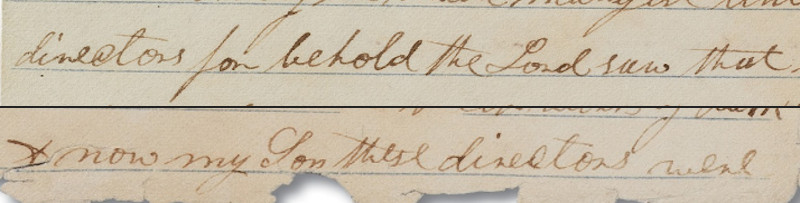
Retain From this People
“And now, my son, I command you that ye retain all their oaths, and their covenants, and their agreements in their secret abominations; yea, and all their signs and their wonders ye shall retain from this people, that they know them not …” (Alma 37:27).
The word “retain” appears twice in this sentence in the 1830 edition, but in the current edition the second occurrence is changed to “keep.” It seems like the change uses the more correct verb for the intended meaning. The printer’s manuscript and original manuscript both say “retain,” so this is a later edit.

Counsel the Lord
“Counsel the Lord in all thy doings, and he will direct thee for good …” (Alma 37:37).
Wait, what? Is the Book of Mormon encouraging us to “counsel the Lord?” That is what the original manuscript, the printer’s manuscript, and the 1830 edition say. In the current edition this has been revised to “counsel with the Lord,” which is doctrinally more correct.
Compare this passage to Jacob 4:10, which reads exactly the same in the 1830 edition as it does today: “Wherefore, brethren, seek not to counsel the Lord, but to take counsel from his hand. For behold, ye yourselves know, that he counseleth in wisdom, and in justice, and in great mercy, over all his works.”
The simplest explanation was that the original wording of Alma 37:37 was an error, but the available evidence doesn’t allow us to trace its source. It could have been an omission by Joseph Smith or by his scribe during the translation, or it could have been a writing error by Alma or Mormon. It does not appear to be an error during transcription or printing.

Counsel Your Elder Brothers
“And I command you to take it upon you to counsel your elder brothers in your undertakings …” (Alma 39:10).
This is similar to the previous passage; the word “with” has been added after “counsel” in the current edition. The printer’s manuscript reads the same as the 1830 edition, and the sentence cannot be discerned in the original manuscript. Obviously it makes no sense for the wayward younger brother to counsel his older brothers. I wonder if this was a language construction that would have made sense to people in the 19th century? Or maybe it was simply an error.

Retain that Wrong
“… but rather return unto them, and acknowledge your faults and retain that wrong which ye have done” (Alma 39:13).
The word “retain” is removed from the current edition. I can’t discern the words on the original manuscript, but according to the annotation at the Joseph Smith Papers the line reads, “… acknowledge your faults and repair that wrong which ye have done (emphasis added).” Apparently there is some uncertainty, and the easiest solution was to simply omit the word, because the sentence makes good doctrinal sense without it.

I Cannot Retain the Words
“Now I cannot retain the words which I have spoken …” (Alma 44:11).
This sentence doesn’t actually make sense. In the current edition the word “retain” is replaced with “recall.” The printer’s manuscript also says “retain,” and there is no annotation on the Joseph Smith Papers website. I assume that this was a later edit to improve the clarity, but it is not clear where the error happened. Was it a transcription or translation error? Did Mormon write it that way? Did Moroni say it that way? We don’t know. Or did “retain” have a wider meaning in 1830 than it has today?

He Gave All the Land
“And it came to pass that when he had poured out his soul to God, he gave all the land which was south of the land Desolation, yea, and in fine, all the land, both on the north and on the south—A chosen land, and the land of liberty” (Alma 46:17).
In the current edition the word “gave” is replaced with “named.” The original phrasing suggests that the writer meant to say, “he gave all the land a name,” but then the description of the geography of the land distracted the writer from completing the thought, and he skipped right to the name. Maybe this was Mormon’s error. It is uncorrected on the printer’s manuscript.
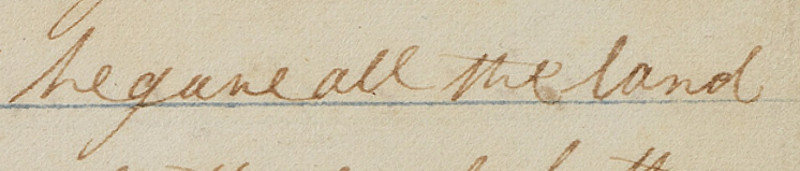
Waving the Rent of His Garment
“And when Moroni had said these words, he went forth among the people, waving the rent of his garment in the air, that all might see the writing which he had wrote upon the rent, and crying with a loud voice …” (Alma 47:19).
In the current printing the word “part” has been inserted after the word “rent” on both occurrences, so that it reads “rent part.” The printer’s manuscript simply says “rent” in both instances, so adding the word “part” must have happened later. Also notice that the word “wrote” was later changed to “written.”

Subsequent to Man
“… many plants and roots which God had prepared, to remove the cause of diseases which was subsequent to man by the nature of the climate” (Alma 46:40).
The phrase “which was subsequent to man” was replaced in later printings with “to which men were subject.” Also notice that there were a couple of transcription errors on the printer’s manuscript that were apparently corrected before or during the printing process: “move” was corrected to “remove” and the word “cause” was written above the line.

The Numerority
“… for behold, his army had been reduced by the Lamanites because
of the numerority oftheir forces having slain a vast number of our men, for which cause we have to mourn” (Alma 56:10).
This one is a little weird. “Numerority” is not a real word. I couldn’t find any references to it online, except in websites referring to this verse in the 1830 edition of the Book of Mormon. Perhaps the word “numerosity” should have been used, which has the meaning that this passage seems to imply. You could almost imagine that the second “r” in the word is actually an “s,” when you compare it to the “s” in “because” and in “forces.” Others have suggested the right word here is “enormity,” but the manuscript clearly doesn’t say that. The original manuscript is illegible in that word. Regardless, the words “of the numerority of” were removed in a later edition, and the verb “having” was changed to “had.” Problem solved.
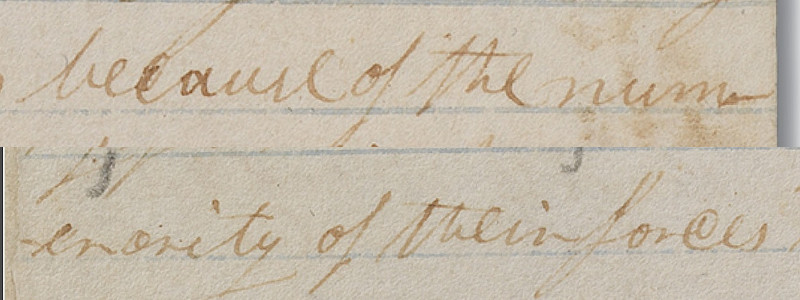
Missing the Reproach of Thy Youth
“Fear not; for thou shalt not be ashamed: neither be thou confounded: for thou shalt not be put to shame: for thou shalt forget the shame of thy youth,
and shalt not remember the reproach of thy youth,and shalt not remember the reproach of thy widowhood any more” (3 Nephi 22:4).
The phrase that is struck out in the verse above is not present in the 1830 edition, but was added to the 1837 printing. It is neither present in Isaiah 54:4 in the King James Version, nor in the Joseph Smith Translation of it. This page is missing from the original manuscript, so we do not know if it was present there. As far as I can gather there is no explanation given for the addition of this phrase. Having said that, I don’t think that the addition of this phrase really alters the meaning of the verse.

Were Not, or Did Not
“Nevertheless, the Lord was merciful unto Omer, and also to his sons and to his daughters
which were not, orwhich did not seek his destruction” (Ether 9:2).
Later editions remove the phrase “which were not, or,” and the word “which” was changed to “who.” The printer’s manuscript shows this later edit made by hand in a thick pen, and it appears that “which” was changed to “who” before it was decided to remove the phrase. Perhaps this was an engraving error by Moroni, as has been suggested about Alma 24:19.

Dissented or Deserted
“And if it so be that they perish, we know that many of our brethren have dissented over unto the Lamanites, and many more will also dissent over unto them” (Moroni 9:24).
The current edition changes the word “dissent[ed]” to “desert[ed]” in this verse. I suppose that “deserted” is a more accurate verb to use in the context of a military conflict.

Conclusion
I am intrigued by the Book of Mormon passages where the writer expresses anxiety about or admits weakness in his writing skills. Consider the following, all written by Moroni, and given as they appear in the 1830 printing (with changes highlighted):
“And now if there be fault, it be the mistake of men ; wherefore, condemn not the things of God, that ye may be found spotless at the judgment-seat of CHRIST” (Title Page).
“And I said unto him, Lord, the Gentiles will mock at these things, because of our weakness in writing : for Lord, thou hast made us mighty in word by faith, whereunto thou hast not made us mighty in writing: for thou hast made all this people that they could speak much, because of the Holy Ghost which thou hast given them” (Ether 12:23).
“Condemn me not because of mine imperfection ; neither my father, because of his imperfection ; neither them which have written before him; but rather give thanks unto God that he hath made manifest unto you our imperfections, that ye may learn to be more wise than that which we have been.” (Mormon 9:31).
It’s hard to know how much of this is Moroni’s grammar and how much of it is Joseph Smith’s, but I don’t suppose that matters very much. They were both men with insufficient training for the work they were assigned, and yet God wanted them to try their best. They consecrated their imperfect talent, and the result was good enough.
Moroni was correct about the mockery the book would sometimes attract from modern audiences, but I wonder how clever Mark Twain and others will feel when the Lord asks them, “Did I not declare my words unto you, which were written by this man, like as one crying from the dead, yea, even as one speaking out of the dust?” (Moroni 10:27).
Reading these passages in the 1830 edition gave me a new sense of appreciation for just how difficult a job it was to translate and publish the Book of Mormon. Of course there were mistakes in the work; it was a Herculean task!
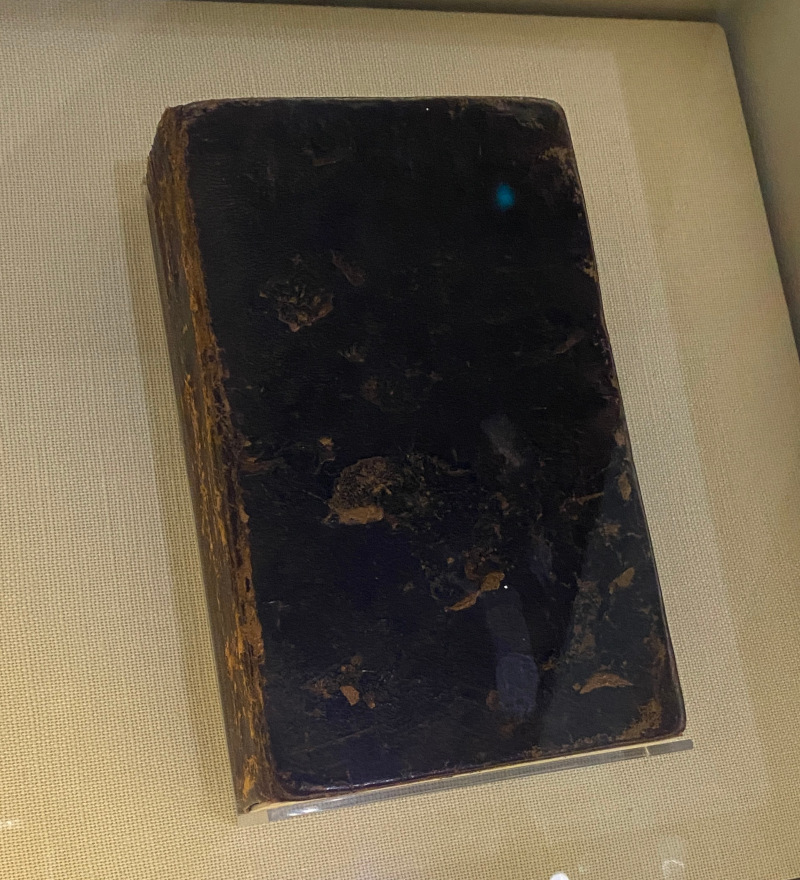
Even with its quirks, this first edition had remarkable power to convince the honest in heart that Jesus Christ had called Joseph Smith to restore his Church. Here is how Parley P. Pratt described his first encounter with the 1830 edition:
“I opened it with eagerness, and read its title page. I then read the testimony of several witnesses in relation to the manner of its being found and translated. After this I commenced its contents by course. I read all day; eating was a burden, I had no desire for food; sleep was a burden when the night came, for I preferred reading to sleep.
“As I read, the spirit of the Lord was upon me, and I knew and comprehended that the book was true, as plainly and manifestly as a man comprehends and knows that he exists. My joy was now full, as it were, and I rejoiced sufficiently to more than pay me for all the sorrows, sacrifices and toils of my life.
“I esteemed the Book, or the information contained in it, more than all the riches of the world. Yes; I verily believe that I would not at that time have exchanged the knowledge I then possessed, for a legal title to all the beautiful farms, houses, villages and property which passed in review before me, on my journey through one of the most flourishing settlements of western New York” (The Autobiography of Parley P. Pratt, chapter 5).
And the book still has that power today. As a young missionary I testified nearly every day that the book was true. All these years later I still know it. It has brought me “nearer to God by abiding by its precepts than … any other book” (Joseph Smith, quoted in the Introduction to the Book of Mormon).
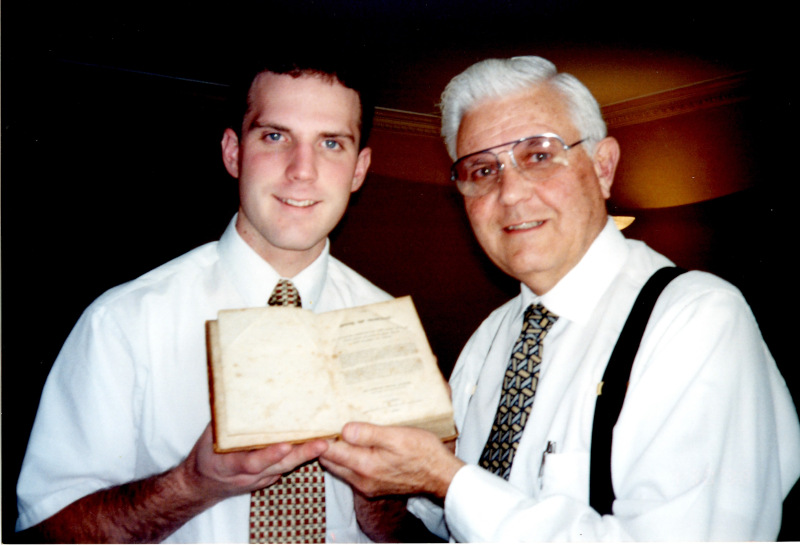
I remember speaking with a man on the street in England. He would not accept my testimony of the Book of Mormon because he said that the book had been changed since its original printing. I was aware of this paragraph from the introductory pages of the book, and shared it with him:
“Some minor errors in the text have been perpetuated in past editions of the Book of Mormon. This edition contains corrections that seem appropriate to bring the material into conformity with prepublication manuscripts and early editions edited by the Prophet Joseph Smith” (A Brief Explanation about the Book of Mormon).
Unfortunately this did not resolve his concerns. He felt that I was being naive and had been deceived, so we parted ways.
It has been 26 years since that meeting. Now that I have made a serious personal study of the 1830 edition of the Book of Mormon I can say that I agree with the statement quoted above. I was surprised at the quantity of revisions, but I do think they are all relatively “minor.” It is a good thing, and not a scandal, that subsequent printings have tried to correct those errors. Who has authority to make those corrections if not the Lord’s Church?
“Under the direction of the Lord’s prophets and apostles, the Church provides and preserves the word of God as found in the holy scriptures. The scriptures testify of Christ, teach His gospel, and help us exercise faith in Him” (General Handbook: Serving in The Church of Jesus Christ of Latter-day Saints, ch.1)
In the revisions that have been made to the Book of Mormon since 1830 we can see the Church of Jesus Christ of Latter-day Saints embracing its role as the steward of God’s word.
I am a work in progress; it doesn’t shake my faith to learn that the Book of Mormon was too. In fact, it gives me hope that the Lord will keep working on me — revising my verbs, correcting my typos, cleaning up my grammar — so that I will have greater power to point people to Christ.

Alan B. Sanderson, MD is a member of The Church of Jesus Christ of Latter-day Saints and is a practicing neurologist.



 Medicine and Faith