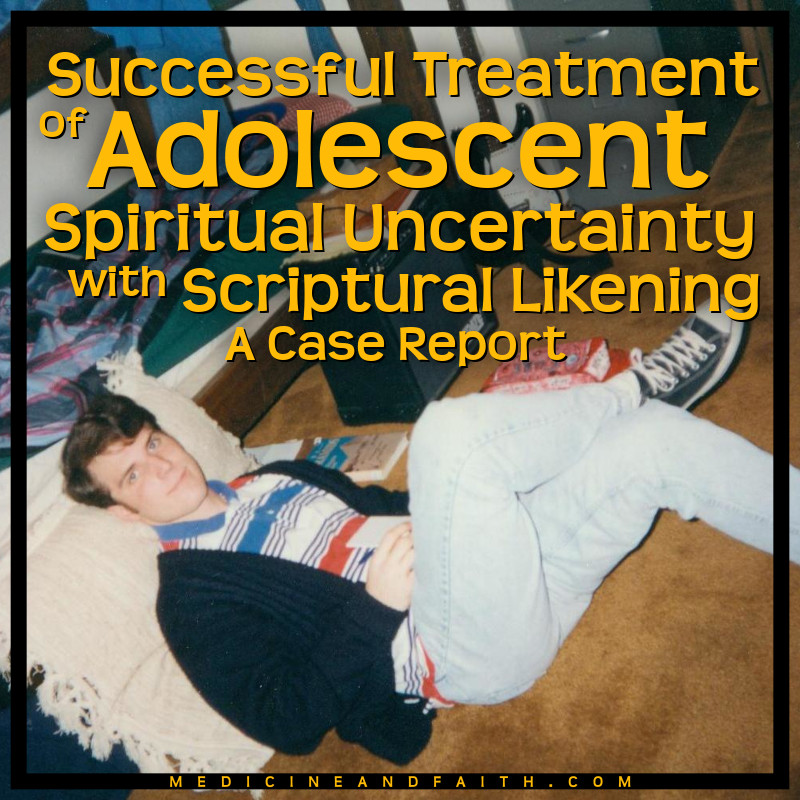
Note: This post was written as a chapter for a book I am working on. It is a parody of a medical journal article. As I revised the book, the style of this chapter seemed out of place, so I decided to rewrite the chapter and use this original idea as a blog post instead. If you would like to preview the book, please see this post.
Abstract
An adolescent male reads and applies scripture to his personal situation, producing positive change in his life. Comparison is made to previously published cases.
Introduction
Adolescence is a time of rapid physical, emotional, social, and cognitive change, and many adolescents experience uncertainty in spiritual beliefs. The optimal treatment for adolescent spiritual uncertainty (ASU) is unknown, as no one method has proven to be effective for all adolescents.
The Book of Mormon prophet Nephi documented his own adolescence and that of his brothers, in one of the most detailed scriptural accounts of ASU.1 The principle of likening — or personally applying the stories and teachings found in the scriptures — was central to Nephi’s approach. Nephi reported that he “did liken all scriptures unto us, that it might be for our profit and learning.”2
Here we report a case of ASU which responded to likening.
Case Report
A 16-year old previously agnostic male had experienced limited and temporary benefits from applying Alma’s experiment.3 In the patient’s personal scripture study one evening he reviewed the following passage from the narrative of Joseph Smith:
“… I have actually seen a vision; and who am I that I can withstand God, or why does the world think to make me deny what I have actually seen? For I had seen a vision; I knew it, and I knew that God knew it, and I could not deny it, neither dared I do it; at least I knew that by so doing I would offend God, and come under condemnation.”4
The patient likened the passage to himself, reasoning that his own experience of feeling and recognizing the influence of the Holy Ghost was a revelation from God, similar to Smith’s first vision.5 If God would be offended by Smith’s denial of the first vision, then God would also be disappointed in the patient’s inconsistency. Smith’s example increased the patient’s desire to be faithful to his own witness.
When the patient restarted Alma’s experiment after this, he found that it was easier to stay focused, and he was able to “nourish [the seed] with great care, that it may get root, that it may grow up, and bring forth fruit.”6 The patient described this as a major turning point in his conversion, and it prepared him to make an important decision. The patient reported the following:
“A few months later my older brother left to serve a mission, and his letters home to the family changed my life forever. He described what it was like to live 100% of his time focused on learning, living, and teaching the gospel, and it made me want to do the same thing. The gospel experiment I had started a few months before had given me enough of a taste for the fruits of the gospel that I was ready to sign up for a feast. Or, to use a different metaphor, I had enjoyed getting my feet wet in the living waters, and I wanted an immersion experience. So I stood up in front of my congregation during a Sunday meeting and said over the pulpit that I wanted to serve a mission, and I committed myself to be ready when the time came.”7
Discussion
ASU is a common disorder affecting millions of young people throughout the world. Known treatments include parental instruction8-12, scripture study13-14, peer support15-16, and fasting with prayer.17
Likening the scriptures unto yourself is a technique most closely associated with Nephi, although others have used it.18-20 Nephi had mixed results from using the technique with his brothers.21
In the present case the patient had reduction in the symptoms of ASU after he likened a scripture to himself. It is unknown whether the effectiveness of likening is increased by self-administration versus guided likening by a teacher or mentor, but this does seem likely.
We also note that the scriptural passage that the patient likened to himself also contains an example of likening. In the preceding verse Smith compares his situation to that of the Apostle Paul testifying before King Agrippa.22-23 It is unknown whether nested likening — where the passage used in likening contains an embedded instance of likening — increases its potency. Further study will be needed to verify this.
Conclusion
Likening may be a useful technique in treating ASU. Further study is needed to determine whether self-administration or nested likening alters the treatment outcome.
References
- 1 Nephi 1-22, 2 Nephi 1-5
- 1 Nephi 19:23
- Alma 32:27-43
- Joseph Smith—History 1:25
- Joseph Smith—History 1:5-20
- Alma 32:37
- A British Summer: My Experience as a Latter-day Saint Missionary
- 1 Nephi 1:1
- Enos 1:1-3
- Alma 36:17
- First Presidency Letter, 2/11/1999
- Alma 56:47-48
- Joseph Smith—History 1:11-13
- 2 Timothy 3:15
- Daniel 1
- 1 Nephi 2:17
- Mosiah 27:14,21-23
- Job 31:33-34
- Deuteronomy 9:5-6
- Alma 46:23-27
- 2 Nephi 5:1-6
- Joseph Smith—History 1:24
- Acts 26
Alan B. Sanderson, MD is a member of The Church of Jesus Christ of Latter-day Saints and is a practicing neurologist.



 Medicine and Faith