Introduction
The Book of Mormon contains many passages of internal commentary. These are verses where the narrator pauses to tell us, the reader, what lesson he wants us to learn from the history he is writing. If you want to know the essential messages of the book, then looking at all of these commentary passages together seems like a good idea.
Methods
I started by reading a paper copy of the Book of Mormon in which I marked all of the commentary passages I noticed, and I compiled these into a spreadsheet. Next I conducted a text search in the digital edition of the book for the words “And thus we see,” and related phrases. This yielded a few more commentary verses that I had skipped over on my first pass, and I added these to my list.
Early in the project I also marked the passages which pertained to record keeping, which are numerous in the book. When I compiled the original list and started considering how to approach a summary blog post of what I had found in my studies, I decided to spin off the record keeping passages into a separate project because they were interesting for different reasons. Stay tuned for another post on that subject in the coming months.
Results
Here is a summary table of the internal commentary passages I found:
| Narrator | Comments | Verses |
|---|---|---|
| Nephi | 9 | 16 |
| Mormon | 35 | 109 |
| Alma the younger | 3 | 3 |
| Moroni | 6 | 29 |
| Lord | 1 | 2 |
| totals: | 54 | 159 |
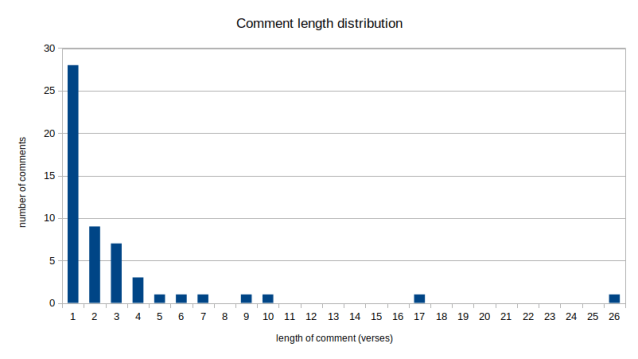
Among the many authors of the book there are three principal commentators: Nephi, Mormon, and Moroni. Alma is a nested commentator, as his writings and speeches are quoted extensively in Mormon’s abridgement, and some of his commentary survives intact within the quoted passages. The one comment attributed to the Lord is within a revelation dictated to Moroni. More than half of the comments in the book consist of a single verse. The longest one is an entire chapter that is 26 verses long.
In the supplementary post you can find the full text of all the narrator commentary passages I identified in the Book of Mormon, along with a brief note about the context and their thematic classification. Table 2 summarizes the broad themes which emerge from a review of these comments:
| Abbreviation | Description | Inclusive Comments | Inclusive Verses | Exclusive Comments | Exclusive Verses | Exclusive Proportion |
|---|---|---|---|---|---|---|
| BOM | The value of scriptures, especially the Book of Mormon | 14 | 34 | 4 | 8 | 23.5% |
| LORD | The Lord’s character and power | 22 | 69 | 3 | 3 | 4.3% |
| FAITH | The reward of the faithful | 27 | 59 | 8 | 10 | 16.9% |
| SIN | The wages of sin | 26 | 62 | 14 | 26 | 41.9% |
An example passage which mentions all four themes is Helaman 3:27:
- LORD: “27 Thus we may see that the Lord is merciful unto all who will, in the sincerity of their hearts, call upon his holy name.”
- FAITH: “28 Yea, thus we see that the gate of heaven is open unto all, even to those who will believe on the name of Jesus Christ, who is the Son of God. 29 Yea, we see that whosoever will may lay hold upon …”
- BOM: “… the word of God, which is quick and powerful, which shall divide asunder all the cunning and the snares and the wiles of the devil, and lead the man of Christ in a strait and narrow course…”
- SIN: “…across that everlasting gulf of misery which is prepared to engulf the wicked — “
- FAITH: “30 And land their souls, yea, their immortal souls, at the right hand of God in the kingdom of heaven, to sit down with Abraham, and Isaac, and with Jacob, and with all our holy fathers, to go no more out” (Helaman 3:27-30).
Correlation with the Stated Purpose of the Authors
How do these four themes align with what the writers felt was the main message of the book? We can examine statements by the principal narrators to answer this question. This is how Nephi, the first narrator, described his writings:
“4 And I know that the Lord God will consecrate my prayers for the gain of my people. And the words which I have written in weakness will be made strong unto them; for it persuadeth them to do good; it maketh known unto them of their fathers; and it speaketh of Jesus, and persuadeth them to believe in him, and to endure to the end, which is life eternal.
“5 And it speaketh harshly against sin, according to the plainness of the truth; wherefore, no man will be angry at the words which I have written save he shall be of the spirit of the devil” (2 Nephi 33:4-5).
I think all four of the major themes are represented there. Here is another passage from Nephi, merging The Lord’s character and power with The reward of the faithful:
“4 For the fulness of mine intent is that I may persuade men to come unto the God of Abraham, and the God of Isaac, and the God of Jacob, and be saved” (1 Nephi 6:4).
Mormon’s last writing, found in chapter 7 of his book, also covers all four topics. Here is an excerpt:
“3 Know ye that ye must come unto repentance, or ye cannot be saved. […]
5 Know ye that ye must come to the knowledge of your fathers, and repent of all your sins and iniquities, and believe in Jesus Christ, that he is the Son of God, and that he was slain by the Jews, and by the power of the Father he hath risen again, whereby he hath gained the victory over the grave; and also in him is the sting of death swallowed up. […]
7 And he hath brought to pass the redemption of the world, whereby he that is found guiltless before him at the judgment day hath it given unto him to dwell in the presence of God in his kingdom, to sing ceaseless praises with the choirs above, unto the Father, and unto the Son, and unto the Holy Ghost, which are one God, in a state of happiness which hath no end.
8 Therefore repent, and be baptized in the name of Jesus, and lay hold upon the gospel of Christ, which shall be set before you, not only in this record but also in the record which shall come unto the Gentiles from the Jews, which record shall come from the Gentiles unto you. (Mormon 7:3,5,7-8).
Moroni’s description of the book’s purpose focuses on The Lord’s character and power:
“Which is to show unto the remnant of the house of Israel what great things the Lord hath done for their fathers; and that they may know the covenants of the Lord, that they are not cast off forever—And also to the convincing of the Jew and Gentile that Jesus is the Christ, the Eternal God, manifesting himself unto all nations” (Title Page of the Book of Mormon).
All considered, I think the four topics are a good summary of what the principal authors of the Book of Mormon wanted to express as its main messages. Let’s take a closer look at each theme individually.
The Value of Scriptures, Especially the Book of Mormon
What do the narrator comments teach us about the scriptures? Here is a summary, with references:
- Joseph of Egypt gave great prophesies about his descendants, including the people in the Book of Mormon. (2 Nephi 4:1-2)
- The writings of Isaiah are hard to understand unless you have some understanding of the ancient Jews and have the Spirit to guide you. (2 Nephi 25:1-4)
- The Book of Mormon is powerful and extremely valuable. (2 Nephi 28:2, 2 Nephi 33:3-5, Words of Mormon 1:3–6, Helaman 3:27-30)
- The Book of Mormon teachings are good. (2 Nephi 33:3-5, Helaman 3:27-30)
- The Book of Mormon gives us knowledge about the ancestors of native Americans. (2 Nephi 33:3-5, Mormon 3:17-22, Mormon 7:1-10)
- The Book of Mormon teaches the gospel of Jesus Christ. (2 Nephi 33:3-5, Words of Mormon 1:3–6, Mormon 3:17-22, Mormon 7:1-10)
- The Book of Mormon warns about the consequences of sin. (2 Nephi 33:3-5, Helaman 2:12-14)
- The message of the Book of Mormon is important for everyone. (Mosiah 28:19)
- The scriptures teach us how to overcome Satan. (Helaman 3:27-30)
- Following the teachings in the scriptures leads to salvation. (Helaman 3:27-30)
- The Book of Mormon is a sign that God is gathering his people. (3 Nephi 29:1-9, Ether 4:17-18)
- The prophecies in the scriptures will be fulfilled. (3 Nephi 29:1-9)
- Those who accept the Book of Mormon will also receive more of the word of God. (Mormon 8:12)
- Those who pray to know the truth of the Book of Mormon will receive a witness from the Holy Ghost. (Moroni 10:3-4)
The Lord’s Character and Power
In the Lectures on Faith, Joseph Smith taught this about the character of God:
“Let us here observe, that three things are necessary, in order that any rational and intelligent being may exercise faith in God unto life and salvation.
“First, The idea that he actually exists.
“Secondly, A correct idea of his character, perfections and attributes.
“Thirdly, An actual knowledge that the course of life which he is pursuing, is according to his will.” (Lectures on Faith, Lecture Third: The Character of God.)
Here is a summary of what we can learn about the Lord’s character, perfections, and attributes from the narrator commentary in the Book of Mormon:
- He will strengthen and bless those who have faith. (1 Nephi 1:20, 1 Nephi 17:3, Helaman 12:1-26)
- He knows all things. (1 Nephi 9:6)
- He has incredible power to accomplish whatever he wants to do. (1 Nephi 9:6, Alma 9:5, Alma 45:19, Helaman 12:1-26, 3 Nephi 29:1-9, Mormon 5:22-24)
- He is constant and unchanging. (1 Nephi 10:18-19)
- He can use small or unusual means to accomplish great things. (1 Nephi 16:29, Alma 24:27)
- He answers prayers. (2 Nephi 33:3-5, Ether 12:6-22, Moroni 10:3-4)
- He tests or tries his people. (Mosiah 23:21-23, Helaman 12:1-26)
- He can deliver people from bondage. (Mosiah 23:21-23, Helaman 12:1-26)
- He can protect us from danger. (Alma 19:23, Helaman 12:1-26)
- He will forgive anyone who will have faith and repent. (Alma 19:36, Helaman 3:27-30, Helaman 12:1-26, Mormon 7:1-10, Ether 12:6-22)
- He is wise. (Alma 29:8)
- He is just. (Alma 29:8, Alma 50:19-23)
- He is true. (Alma 29:8)
- He is merciful. (Alma 50:19-23, Helaman 3:27-30, Moroni 10:3-4)
- He punishes sin. (Helaman 12:1-26, 3 Nephi 29:1-9)
- He keeps his covenants. (3 Nephi 29:1-9)
- He will give our final judgement. (Mormon 3:17-22, Mormon 7:1-10)
- He overcame death and sin. (Mormon 7:1-10)
- He reveals himself to those who have faith. (Ether 12:6-22, Moroni 10:3-4)
The Reward of the Faithful
What blessings are reserved for the faithful disciples of Christ? Here is what the narrators taught:
- God will strengthen, deliver, and protect them. (1 Nephi 1:20, 1 Nephi 17:3, Mosiah 23:21-23, Alma 19:23, Alma 24:19, Alma 48:10, Alma 50:19-23, Helaman 12:1-26)
- God will reveal truth to them. (1 Nephi 10:18-19, 1 Nephi 16:29, Mormon 8:12, Ether 12:6-22, Moroni 10:3-4)
- God will answer their prayers. (2 Nephi 33:3-5, Ether 12:6-22)
- They will have eternal life with God. (2 Nephi 33:3-5, Alma 45:19, Helaman 3:27-30, Helaman 12:1-26, Mormon 7:1-10, Ether 12:6-22)
- Coming unto Christ will be a beautiful experience. (Mosiah 18:30)
- They will have the Spirit with them. (Alma 19:36, Helaman 6:34-36, 3 Nephi 30:1-2)
- They will have joy. (Alma 28:13-14, Alma 50:19-23, Mormon 7:1-10)
- They will overcome Satan. (Alma 48:17, Helaman 3:27-30)
- They will prosper in the land. (Alma 50:19-23, Helaman 12:1-26, 3 Nephi 6:5-6, Ether 10:28)
- They will have mercy and salvation. (Helaman 3:27-30, 3 Nephi 30:1-2, Ether 4:17-18)
- They will have peace. (3 Nephi 6:5-6)
- They receive the ordinances of the gospel. (3 Nephi 7:24, 3 Nephi 30:1-2)
- They will be numbered among the Lord’s people. (3 Nephi 30:1-2, Mormon 7:1-10)
- They will have power to perform miracles. (Ether 12:6-22)
The Wages of Sin
What are the natural consequences of disobeying the Lord?
- The wrath and judgements of God. (2 Nephi 25:1-4, 3 Nephi 29:1-9, Mormon 4:4-5, Mormon 5:22-24, Ether 8:20-26, Ether 14:25)
- Influenced by the spirit of the devil. (2 Nephi 33:3-5, Alma 28:13-14)
- We bring upon ourselves our own condemnation. (Alma 3:19)
- Those who fall from righteousness into sin are worse off than if they had never known righteousness. (Alma 24:30, Alma 47:36)
- It causes inequality. (Alma 28:13-14)
- The devil does not support his followers, but quickly drags them down to destruction. (Alma 30:60)
- Loss of liberty. (Alma 46:8-10, Alma 50:19-23)
- Cut off from knowledge, influence, and presence of the Lord. (Alma 9:3, Alma 9:5, Alma 47:36, Alma 50:19-23, Helaman 6:34-36, Helaman 12:1-26)
- War and destruction. (Alma 50:19-23, Helaman 4:11-13, Helaman 6:40, Helaman 12:1-26, Helaman 12:1-26, Mormon 4:4-5, Mormon 4:11-12, Mormon 5:22-24, Ether 8:20-26, Ether 14:25)
- Dwindling in unbelief. (Alma 50:19-23)
- Jeopardization of security and civilization. (Alma 53:9, Helaman 2:12-14, Ether 8:20-26, Ether 14:25)
- Eternal damnation and misery. (Helaman 3:27-30, Helaman 12:1-26, 3 Nephi 29:1-9, Mormon 7:1-10, Ether 4:17-18)
- Loss of the Lord’s protection and prosperity. (Helaman 4:11-13, Helaman 12:1-26)
Remember that this summary of teachings on the four themes is only taken from the internal commentary of the Book of Mormon. An inclusive study of these themes in the entire book would likely yield more teachings in each category.
Combination of Themes
We can also learn a few things by observing how these four topics are grouped together, as listed in Table 3:
| Combination | Comments | Verses |
|---|---|---|
| BOM alone | 4 | 8 |
| LORD alone | 3 | 3 |
| FAITH alone | 8 | 10 |
| SIN alone | 14 | 26 |
| BOM-LORD | 1 | 6 |
| BOM-FAITH | 1 | 1 |
| BOM-LORD-FAITH | 1 | 2 |
| BOM-SIN | 2 | 7 |
| BOM-LORD-SIN | 1 | 9 |
| BOM-FAITH-SIN | 1 | 2 |
| BOM-LORD-FAITH-SIN | 3 | 17 |
| LORD-FAITH | 9 | 28 |
| LORD-SIN | 2 | 4 |
| LORD-FAITH-SIN | 1 | 26 |
| FAITH-SIN | 2 | 5 |
Notice that some topics are highly correlated. The Lord’s character and power and The reward of the faithful appear together at least three times more commonly than any other combination, and more than either of the two themes by themselves.
The Lord’s character and power appears in isolation only 4.3% of the time. In contrast, The wages of sin occurs in more than twice as many comments by itself as it does in combination with other topics. I suppose that it’s enough by itself to say that sin is bad, but it’s hard to say enough about how many ways the Lord is good.
Helaman 12: The Longest Comment
Special mention should be made of the longest passage of internal commentary in the Book of Mormon, which comprises the entire chapter of Helaman 12. Notice how the themes of The Lord’s character and power, The reward of the faithful, and The wages of sin are woven together and interrelated in the opening verses of the chapter:
“1 And thus we can behold how false, and also the unsteadiness of the hearts of the children of men; yea, we can see that the Lord in his great infinite goodness doth bless and prosper those who put their trust in him.
“2 Yea, and we may see at the very time when he doth prosper his people, yea, in the increase of their fields, their flocks and their herds, and in gold, and in silver, and in all manner of precious things of every kind and art; sparing their lives, and delivering them out of the hands of their enemies; softening the hearts of their enemies that they should not declare wars against them; yea, and in fine, doing all things for the welfare and happiness of his people; yea, then is the time that they do harden their hearts, and do forget the Lord their God, and do trample under their feet the Holy One—yea, and this because of their ease, and their exceedingly great prosperity.
“3 And thus we see that except the Lord doth chasten his people with many afflictions, yea, except he doth visit them with death and with terror, and with famine and with all manner of pestilence, they will not remember him” (Helaman 12:1-3).
The Lord’s character and power provides The reward of the faithful, but the people tend to forget the Lord when their lives are so blessed. Thus, The wages of sin are part of how the Lord helps his people to remember him. People are stubbornly independent to the point of refusing instruction from an all-wise and loving Father in heaven:
“6 Behold, they do not desire that the Lord their God, who hath created them, should rule and reign over them; notwithstanding his great goodness and his mercy towards them, they do set at naught his counsels, and they will not that he should be their guide” (Helaman 12:6).
The middle part of the chapter describes the Lord’s awesome power. Verses 8-16 describe his authority over nature, to move the earth and mountains, and even to change the movement of heavenly bodies. Then in verses 17-22 Mormon describes how this power can be used to punish sin, by making buried treasures inaccessible, by causing mass destruction of cities, and by decreeing that sinners cannot be saved.
The concluding verses again weave back in the theme of The reward of the faithful as Mormon encourages us to repent:
“23 Therefore, blessed are they who will repent and hearken unto the voice of the Lord their God; for these are they that shall be saved.
“24 And may God grant, in his great fulness, that men might be brought unto repentance and good works, that they might be restored unto grace for grace, according to their works.
“25 And I would that all men might be saved. But we read that in the great and last day there are some who shall be cast out, yea, who shall be cast off from the presence of the Lord;
“26 Yea, who shall be consigned to a state of endless misery, fulfilling the words which say: They that have done good shall have everlasting life; and they that have done evil shall have everlasting damnation. And thus it is. Amen” (Helaman 12:23-26)
Having thus lectured on The Lord’s character and power, The reward of the faithful, and The wages of sin, Mormon proceeds to tell the story of Samuel the Lamanite, who spends the next three chapters discoursing on the same three themes.
Conclusion
I love the Book of Mormon. It is far and away my favorite book, and the one that has had the biggest influence on my life and my relationship with God. Every word of it is true.
President Russel M. Nelson has described his own personal study of the Book of Mormon:
“I’ve made lists of what the Book of Mormon is, what it affirms, what it refutes, what it fulfills, what it clarifies, and what it reveals. Looking at the Book of Mormon through these lenses has been an insightful and inspiring exercise! I recommend it to each of you.” (October 2017 General Conference)
Seeing the Book of Mormon through various lenses is a key to learning something new each time we read it. Like President Nelson, I highly recommend this kind of study activity. I feel like I know the narrators of the book in a more personal way now, because I understand what was most important to them about their writing.
Read the Book of Mormon. Study it through different lenses. Believe its message. The scriptures are valuable. The Lord is powerful and good, and wants to help us. Sin leads to bad consequences, but if you repent and follow the Lord, you will be blessed.
More posts about scripture study:


Something went wrong. Please refresh the page and/or try again.
Alan B. Sanderson, MD is a member of The Church of Jesus Christ of Latter-day Saints and is a practicing neurologist.



 Medicine and Faith
Thank you for this thoughtful and well done analysis of the lessons of the Book of Mormon. I’ll save it and share it with Shannon.
LikeLiked by 1 person