This is part three of a three-part series about record keeping in the Book of Mormon:
- The Difficulty of Engraving Our Words
- Written by Way of Commandment
- The Record Which I Make is True
What makes a good writer? It is largely his or her ability to connect in a personal way with the reader. A mighty vocabulary is optional. A loathsome topic can be worked around, given enough skill. But good writing must make the reader feel like they have a relationship with the writer.
What makes the Book of Mormon such a powerful witness of Jesus Christ? What gives it such power to convert souls into disciples? How is it true, as Joseph Smith said, that “a man would get nearer to God by abiding by its precepts, than by any other book” (Introduction to the Book of Mormon)? Part of the answer to those questions is that the authors from beginning to end were focused on you, the reader.
Intended Audience
Who did the writers have in mind while writing? Compare these two passages from Nephi and from Mormon, written at the respective dawn and dusk of Nephite civilization:
“And now, my beloved brethren, and also Jew, and all ye ends of the earth, hearken unto these words and believe in Christ; and if ye believe not in these words believe in Christ. And if ye shall believe in Christ ye will believe in these words, for they are the words of Christ, and he hath given them unto me; and they teach all men that they should do good.
“And now, my beloved brethren, all those who are of the house of Israel, and all ye ends of the earth, I speak unto you as the voice of one crying from the dust: Farewell until that great day shall come” (2 Nephi 33:10,13, emphasis added).“Therefore I write unto you, Gentiles, and also unto you, house of Israel, when the work shall commence, that ye shall be about to prepare to return to the land of your inheritance;
“Yea, behold, I write unto all the ends of the earth; yea, unto you, twelve tribes of Israel, who shall be judged according to your works by the twelve whom Jesus chose to be his disciples in the land of Jerusalem.
“And I write also unto the remnant of this people, who shall also be judged by the twelve whom Jesus chose in this land; and they shall be judged by the other twelve whom Jesus chose in the land of Jerusalem” (Mormon 3:17-19, emphasis added).
The intended audience for the Book of Mormon is huge! It was meant for every eye and every heart — every person on earth. Here is a list of audiences mentioned specifically by one or more Book of Mormon writers, and a summary of what the writer hopes the book will do for that group.
- The Lamanites (Title Page, Enos 1:13-16, Jarom 1:2, Alma 37:8-10, Alma 37:19, Moroni 1:4, Moroni 10:1)
- To bring them to repentance and salvation.
- To convince them of the incorrect tradition of their fathers.
- To bring them to a knowledge of Jesus Christ.
- To bring them joy through the gospel message.
- The Jews (Title Page, 2 Nephi 33:10, 3 Nephi 16:4)
- To convince them that Jesus is the Christ.
- The Gentiles (Title Page, 3 Nephi 16:4, 3 Nephi 23:4, 3 Nephi 26:8, 3 Nephi 30:1, Mormon 3:17-20, Mormon 5:9, Ether 12:23-25)
- To convince them that Jesus is the Christ.
- To encourage them to repent and follow the gospel.
- To let them know of the judgements of God.
- To encourage them to share the message of the Book of Mormon with all of the other groups.
- The house of Israel (Title Page, 1 Nephi 19:19, 2 Nephi 33:13, 3 Nephi 16:4, 4 Nephi 1:49, Mormon 3:17-20, Mormon 5:12)
- To teach them about their ancestors, and the covenant God made with them.
- To bring them to a knowledge of Jesus Christ.
- To teach them of the judgements of God.
- To encourage them to repent.
- The Nephites (1 Nephi 19:3, 1 Nephi 19:18, 2 Nephi 4:15, 2 Nephi 11:2-3, 2 Nephi 11:8, 2 Nephi 25:3, 2 Nephi 25:23, 2 Nephi 25:26, 2 Nephi 33:3-4, 2 Nephi 33:10, 3 Nephi 33:13, Jacob 1:4, Jacob 4:2-3, Jacob 7:27, Words of Mormon 1:2, Words of Mormon 1:6, Alma 37:8-10, 3 Nephi 26:8, Mormon 3:17-20, Mormon 5:9, Mormon 7:1, Ether 12:22)
- To instruct and profit them.
- To teach them of Christ and persuade them to remember him.
- To bring them joy through the gospel message.
- To inform them of the judgements of God.
- To convince them of the error of their ways and teach them how to find remission of their sins.
- To persuade them to do good and endure to the end.
- To teach them about their ancestors and heritage.
- To try their faith.
- All the ends of the earth (2 Nephi 33:10, 2 Nephi 33:13, Omni 1:25, Alma 37:4, Mormon 3:17-20)
- To persuade us to repent and believe in Christ.
- To persuade us to believe in spiritual gifts.
- To teach us the mysteries of God.
- To inform us of the judgements of God.
- The translator of the Book of Mormon (Ether 5)
- Do not translate the sealed portion of the record.
- Choose three witnesses who will be privileged to see the gold plates.
Notice the huge overlap in the writer’s hopes for each of these groups. With the exception of the translator of the book — whom they could safely assume was already on board with the gospel plan — every specific audience is encouraged to come unto Jesus Christ. This invitation is the most important purpose of the Book of Mormon. Whoever you are, whatever group you belong to, whether or not you descend from the ancient patriarchs, you must believe in Jesus and follow him in order to be saved. That message is for all the world.
Ether chapter 5 is unique among passages that address the reader directly, because that chapter has an audience of one. I have wondered how Joseph Smith felt as he read that chapter, knowing that it was written directly to him so many hundreds of years before.
Preservation
Preservation of the record was a major concern of the writers, and was the principal reason for their choice of metal plates as the writing medium (see Jacob 4:1-4). All of the major writers expressed their hope and their prayers and their confidence that the Lord would keep the records safe, so that later generations could read their words.
NEPHI: “Wherefore, for this cause hath the Lord God promised unto me that these things which I write shall be kept and preserved, and handed down unto my seed, from generation to generation, that the promise may be fulfilled unto Joseph, that his seed should never perish as long as the earth should stand” (2 Nephi 25:21, emphasis added).
ENOS: “And it came to pass that after I had prayed and labored with all diligence, the Lord said unto me: I will grant unto thee according to thy desires, because of thy faith. And now behold, this was the desire which I desired of him—that if it should so be, that my people, the Nephites, should fall into transgression, and by any means be destroyed, and the Lamanites should not be destroyed, that the Lord God would preserve a record of my people, the Nephites; even if it so be by the power of his holy arm, that it might be brought forth at some future day unto the Lamanites, that, perhaps, they might be brought unto salvation … Wherefore, I knowing that the Lord God was able to preserve our records, I cried unto him continually, for he had said unto me: Whatsoever thing ye shall ask in faith, believing that ye shall receive in the name of Christ, ye shall receive it. And I had faith, and I did cry unto God that he would preserve the records; and he covenanted with me that he would bring them forth unto the Lamanites in his own due time” (Enos 1:12-16, emphasis added).
ALMA: “Behold, it has been prophesied by our fathers, that they should be kept and handed down from one generation to another, and be kept and preserved by the hand of the Lord until they should go forth unto every nation, kindred, tongue, and people, that they shall know of the mysteries contained thereon” (Alma 37:4, emphasis added).
JESUS: “And I command you that ye shall write these sayings after I am gone, that if it so be that my people at Jerusalem, they who have seen me and been with me in my ministry, do not ask the Father in my name, that they may receive a knowledge of you by the Holy Ghost, and also of the other tribes whom they know not of, that these sayings which ye shall write shall be kept and shall be manifested unto the Gentiles, that through the fulness of the Gentiles, the remnant of their seed, who shall be scattered forth upon the face of the earth because of their unbelief, may be brought in, or may be brought to a knowledge of me, their Redeemer” (3 Nephi 16:4, emphasis added).
MORMON: “And they were handed down from king Benjamin, from generation to generation until they have fallen into my hands. And I, Mormon, pray to God that they may be preserved from this time henceforth. And I know that they will be preserved; for there are great things written upon them, out of which my people and their brethren shall be judged at the great and last day, according to the word of God which is written” (Words of Mormon 1:11, emphasis added).
MORMON: “Now these things are written unto the remnant of the house of Jacob; and they are written after this manner, because it is known of God that wickedness will not bring them forth unto them; and they are to be hid up unto the Lord that they may come forth in his own due time” (Mormon 5:12, emphasis added).
MORONI: “And I am the same who hideth up this record unto the Lord; the plates thereof are of no worth, because of the commandment of the Lord. For he truly saith that no one shall have them to get gain; but the record thereof is of great worth; and whoso shall bring it to light, him will the Lord bless. For none can have power to bring it to light save it be given him of God; for God wills that it shall be done with an eye single to his glory, or the welfare of the ancient and long dispersed covenant people of the Lord. And blessed be he that shall bring this thing to light; for it shall be brought out of darkness unto light, according to the word of God; yea, it shall be brought out of the earth, and it shall shine forth out of darkness, and come unto the knowledge of the people; and it shall be done by the power of God” (Mormon 8:14-16, emphasis added).
MORONI: “And it is by faith that my fathers have obtained the promise that these things should come unto their brethren through the Gentiles; therefore the Lord hath commanded me, yea, even Jesus Christ” (Ether 12:22, emphasis added).
Testimony
The Book of Mormon begins and ends with the writers bearing testimony that they know the book they are writing is true. They knew their audience, they knew that their words would reach that audience, and they knew that their words were true. Here is a sampler of their testimonies:
NEPHI: “And I know that the record which I make is true; and I make it with mine own hand; and I make it according to my knowledge” (1 Nephi 1:3).
NEPHI: “And now I make an end of speaking concerning the things which I saw while I was carried away in the Spirit; and if all the things which I saw are not written, the things which I have written are true. And thus it is. Amen” (1 Nephi 14:30).
NEPHI: “And if they are not the words of Christ, judge ye—for Christ will show unto you, with power and great glory, that they are his words, at the last day; and you and I shall stand face to face before his bar; and ye shall know that I have been commanded of him to write these things, notwithstanding my weakness” (2 Nephi 33:11).
MORMON: “And I know the record which I make to be a just and a true record” (3 Nephi 5:18).
MORONI: “And when ye shall receive these things, I would exhort you that ye would ask God, the Eternal Father, in the name of Christ, if these things are not true; and if ye shall ask with a sincere heart, with real intent, having faith in Christ, he will manifest the truth of it unto you, by the power of the Holy Ghost” (Moroni 10:4).
MORONI: “And I exhort you to remember these things; for the time speedily cometh that ye shall know that I lie not, for ye shall see me at the bar of God; and the Lord God will say unto you: Did I not declare my words unto you, which were written by this man, like as one crying from the dead, yea, even as one speaking out of the dust?” (Moroni 10:27)
MORONI: “And God shall show unto you, that that which I have written is true” (Moroni 10:29).
Not only do they give their own testimony, but they promise and prophesy that God will also testify to us that the Book of Mormon is his word.
How confident are you that you are doing God’s work in your life? Would you be willing to give the same promise these men gave: that God will add his testimony to yours at the last day? That he will confirm that he commanded you to do the things you are doing?
Conclusion
What a remarkable book! Painstakingly produced using difficult technology over 1,000 years, built to endure through the ages, addressed to every human soul on earth, the Book of Mormon was written as a testimony of Jesus Christ and as the means to gather his people to him and to build his kingdom on earth, in preparation for his Second Coming.
Every time I study it I grow a deeper conviction that it is true. The men who wrote the Book of Mormon were honest and faithful men of God. Their book stands as a powerful testimony that God will accomplish his work — all of it — even the work that might be buried underground for a few centuries. If you feel like you aren’t making any progress in your life, that nothing is working out for you, that you are buried and forgotten, know that you are not forgotten by God.
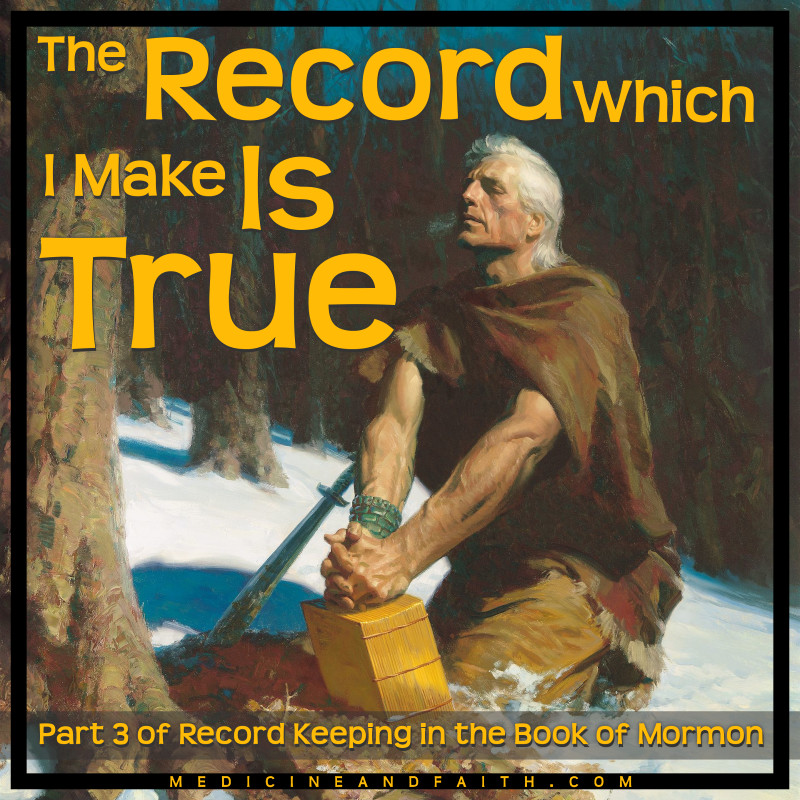
Cover image: Moroni Hides the Plates in the Hill Cumorah (Moroni Burying the Plates), by Tom Lovell
Alan B. Sanderson, MD is a member of The Church of Jesus Christ of Latter-day Saints and is a practicing neurologist.



 Medicine and Faith
Hi, Alan.
I believe I have read all of your Medicine and Faith blogs and I really enjoy them. You do a great job and your dedication to the Lord and His scriptures really shows.
In regards to your most recent post, you made a list of the intended audiences of The Book of Mormon. I wanted to suggest that there is one more audience that is specifically spoken to. It would be the current inhabitants of the promised land and the nation that possesses it. The message being that those who wish to live on the promised land must serve the Lord or they will be swept off of the land. As you well know, this requirement is mentioned in many places throughout The Book of Mormon. Ether 2:7-12 is worth special mention because of how clearly this requirement is spelled out. Also, it expands the protections and requirements of the Lord to “whatsoever nation shall possess it” (the promised land).
I just wanted to chime in and add that one. Thanks again for sending those out!
Dave
LikeLike
Hi, Dave. Thanks for reading. I’m glad that someone out there finds this blog useful.
You are right; I glossed over that specific audience, unless you lump them in with the Gentiles. But that particular passage wasn’t caught in my net — probably because it wasn’t specifically about record keeping. That is one limitation of the methodology I used. Sometimes I don’t broaden the net after I look for themes and categories in the passages my search collects.
Thanks for your comment!
Alan
LikeLike