
Lately I have been reading The Brain in Motion by Sten Grillner, who is a neuroscientist from Sweden. The book is not exactly easy reading — it is so full of technical detail and specialized terminology that I could only recommend it for serious nerds — but I have been fascinated with every page.

Grillner has spent years studying and modeling the brain and spinal cord of lampreys, which are jawless fishes. Lampreys (and their cousins, the hagfishes) descend from the earliest vertebrates that first appear in the fossil record during the Cambrian explosion 500 million years ago. These are the ancestors of all vertebrates.
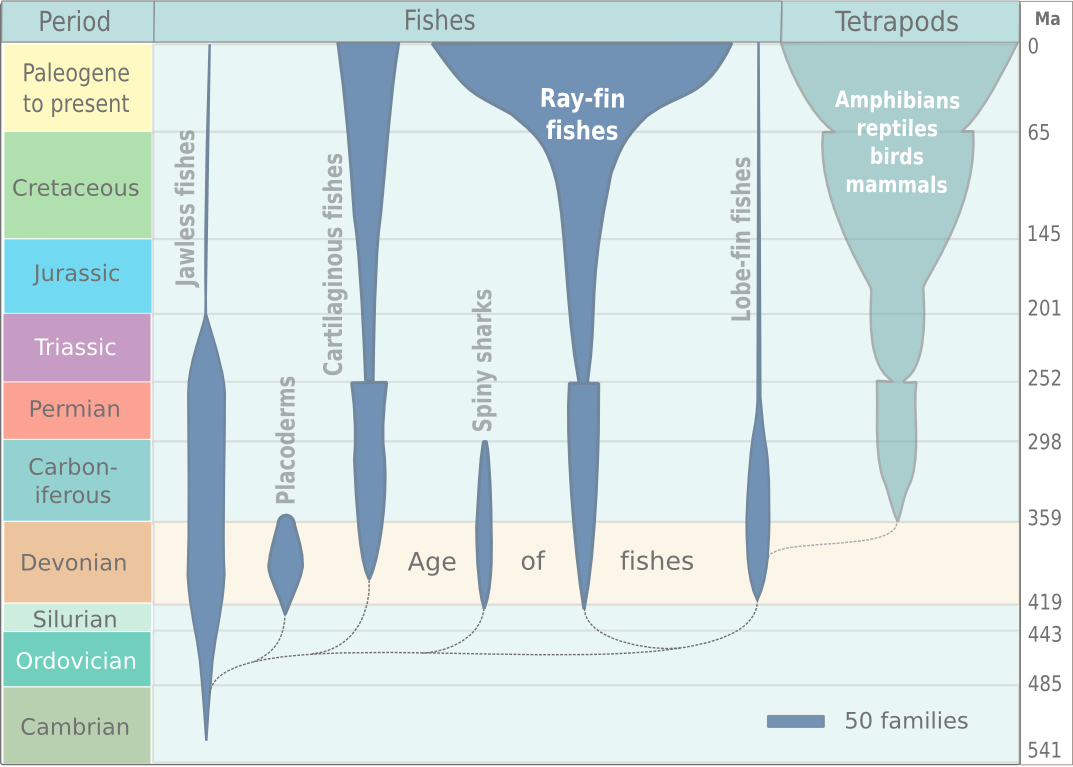
Lampreys do not have lateral fins, and swim by sending waves of “S” shaped contractions down their spine. The neural circuits that produce and control these movements are a network of semi-autonomous microcircuits known as central pattern generators (CPGs) located all up and down the spinal cord, operating under the influence of control circuits in the brainstem and higher brain areas, and adjusting their function in response to feedback from sensory nerves. The whole design of this machine is remarkable and beautiful!
Over the course of vertebrate evolution this basic system has been built up with new features and new CPGs to perform new movements and to make use of new structures. Cartilaginous fishes (sharks, rays, etc.) have paired fins for steering and jaws for biting and grasping prey. Bony fishes can move their paired fins independently, and lungfishes can even walk on them. Amphibians (salamanders, frogs, etc) and reptiles have more robust CPGs for moving limbs during locomotion and for reaching out their forelimbs to grasp objects. These groups have a side-to-side gait pattern that is an adaptation of the swimming body movements of fishes, and uses the same CPG systems inherited from them. Dinosaurs had a different gait pattern, with the limbs underneath the body instead of out to the side. Mammals have new CPGs to control chewing movements of the jaw, and many new gait patterns that are based on arching spine movements instead of side-to-side movements. Primates (monkeys, apes, humans) have new brain circuits for fine motor control of individual fingers of the hand.
All of these additions and adaptations of the vertebrate motor system were built upon the original scaffolding designed for jawless fishes 500 million years ago. As one who has studied human neuroanatomy for the last 25 years, I find this fact simply stunning.

Nostalgia and Conflict
Reading Grillner’s book makes me feel like an undergraduate again. I first learned about comparative vertebrate morphology in a class I took from Dennis Bramble, whose research focused on the anatomical and physiological adaptations for distance running in humans. Evolutionary biology was endlessly fascinating to me.
Charles Darwin had the key insight that the demands of survival in a hostile and changing environment will produce a selective pressure that will, over many generations, effect changes in populations of living organisms. On the Origin of Species, his groundbreaking treatise, points out that selective breeding in agriculture had produced changes over time in domesticated animal and plant species, a process he referred to as “artificial selection.” He proposed the term “natural selection” to refer to the exact same evolutionary process when brought about by competition for survival and reproduction instead of by husbandry.
The most remarkable thing to me about studying biology was that evidence for natural selection was everywhere in all of the sub-disciplines of biology. Geneticists, biochemists, physiologists, and cell biologists didn’t set out to prove that Darwin was right, but independent discoveries in all of these fields pointed to the same conclusion: the diversity of life was created through evolution by natural selection. This is the fundamental theorem of biology, and everything makes sense when viewed through this lens.
All of this was initially troubling to me as a young student, as I struggled through a repeat of the Scopes Monkey Trial within my own soul. The sophomoric conclusion — and I was a sophomore at the time — was that evolution by natural selection provided a mechanism of creation that did not require the supervision of a creator. But the equally sophomoric rebuttal was that absence of evidence is not evidence of absence. I didn’t need evidence for God’s existence or power; I had already seen his hand in my life and had personally communicated with him.
My faith was hard-won, and I didn’t want to sabotage it with secular learning. But I also didn’t want to be ignorant. The evidence and arguments in favor of evolution by natural selection are compelling, and my religion embraces everything which is true. Could I reconcile what I was learning in school with my belief in God as the Creator?
I found the arguments for Intelligent Design to be unhelpful. One of these arguments says that what we observe in the natural world is so improbable that there must have been some intelligence that caused it. Ok, I get that. But improbable events occur reliably with large numbers and a lot of time, which is exactly what we are dealing with in nature. The fact that something was unlikely to occur is not proof that it couldn’t have happened, especially not when that thing is actually here and staring you in the face.
Another common intelligent design argument asserts that some things in nature have irreducible complexity, meaning that you can’t make them any simpler without losing their essential function. This suggests that some complex systems could not have evolved from simpler ones. But Grillner’s book describes pretty well how the human nervous system, which is the most complex thing in the known universe, evolved from simpler forms.
In short, I don’t think there is a way to prove with an irrefutable logical argument that there must be a Creator. But I also believe that science cannot disprove the existence of God. Science is great at answering questions about what, where, and how, but falls on its face over questions about why.
Phone a Friend
Early in my undergraduate years I read Reflections of a Scientist, by Henry Eyring. He was a chemist whose major contribution was applying quantum theory to transition state chemistry. (Fun fact: I started the Wikipedia article about Henry Eyring in 2003 while sitting in a computer lab in the Henry Eyring Building at the University of Utah.)
Eyring was a man of faith as much as he was a man of science. His book is full of insights that helped me work through my cognitive dissonance. I recall a few that had the most impact on me.
First, scientists are generally honest seekers of truth. They are not part of a Satanic conspiracy to deceive the world; they are participants in a marketplace of competing ideas. They want to discover truth in order to increase our understanding of the world and to earn the respect and accolades of their peers. Deception is not the goal of science. I can confirm this observation from my own experience of studying and working in academic science departments and of attending scientific lectures.
Second, Eyring was ok with the idea that other primates are our evolutionary cousins. This gave me permission to seek for and accept some harmony of my religious and scientific beliefs.
Third was Eyring’s viewpoint, which I first learned from my dad when I was a kid, that science is the study of God’s methods. If you believe that God is the Creator, then science is just trying to figure out how he does it. What are the natural laws that he knows and follows? And can we discover them through experimentation and logic?
That last point led me to an obvious conclusion: God used evolution by natural selection to create the diversity of life. At least, he made it look like he did.
Natural Selection and the Character of God
If it is true that natural selection is a creative tool in the hands of God — much like plate tectonics, quantum mechanics, and general relativity must be — then what might we learn about the Creator by studying the way he uses this tool? Or, conversely, is evolution by natural selection consistent with what we know about the character of God?
I think it is.
For starters, we know that creating the diversity of life took about 4 billion years. That is how old the rocks are in which the first microorganism fossils are found. (For perspective, Earth formed about 4.5 billion years ago, so living things appeared about as soon as temperatures started to cool down.) For about 3.5 billion years, life consisted of single-celled or very simple multicellular organisms. It wasn’t until the Cambrian explosion about 540 million years ago that things got really interesting, and in the span of about 20 million years all of the basic body plans of multicellular organisms evolved (including vertebrates, as described above). In human lifespan terms, evolution is agonizingly slow.
What does this teach us about the character of God? He is patient, and he is diligent.
Natural selection acts as an external pressure on the frequency of different traits in a population. God often works in the same way with his children when he wants us to change. He doesn’t force us, but he will use our circumstances to try to persuade us.
“No power or influence can or ought to be maintained by virtue of the priesthood, only by persuasion, by long-suffering, by gentleness and meekness, and by love unfeigned” (Doctrine and Covenants 121:41).
Flying has evolved independently at least three times in vertebrate evolution: pterosaurs, birds, and bats. Each group has used its forelimbs as wings for powered flight. Pterosaurs went extinct right around the time the first birds were taking flight.
God is very consistent. He does the same things over and over again. This pattern can be seen in the dispensations of the gospel, starting with a new prophet after a period of apostasy, teaching his plan of salvation and his commandments to a new group of people over and over again.
All vertebrates have the same basic body plan. As cartilaginous fishes evolved to bony fishes, then to amphibians and reptiles, and as reptiles evolved into birds and mammals, and as mammals evolved into primates and hominids, the old forms were retained and modified, with new features added for each group. Humans have the same bones in the same places that dogs do, but the proportions are different (and our tails are shorter). Dogs have the same brain structures with the same neural network connections (but our frontal lobes are bigger).
The Creator didn’t start from scratch with every new species; he reused, repurposed, and recalibrated his previous work. God’s work is gradual and cumulative, building on what came before. The same is true in how he reveals himself to his children.
“For precept must be upon precept, precept upon precept; line upon line, line upon line; here a little, and there a little” (Isaiah 28:10).
I am amazed by the brilliance and beauty of life. Understanding the design helps me appreciate the forces that created it, and the Creator that wielded those forces.
Conclusion
In 2003 my grandfather had a heart surgery and was in the hospital for several weeks with complications. I would often go to the hospital waiting room to visit with my grandmother after my lectures let out in the afternoon. One day I was telling her about what I was learning in my classes, and I told her my thoughts about how natural selection is consistent with what we know about the character of God. She said to me, “Will you write that down?”
I promised her that I would, but I don’t think I ever did. There were a lot of reasons why. The ideas felt half-baked at the time. My education and my faith were all a work in progress. I didn’t really have a platform or a venue to share these ideas back then. All of those excuses have expired, so I figured it was time to finally do what I promised my grandmother that I would do over 20 years ago.
These ideas may not be very insightful, and I am sure that I am not the first one to think them, but hopefully what I have written here will be helpful to some person out there who is struggling with how to reconcile a belief in God with the conclusions of evolutionary biology. It is not as big of a problem as I once thought it was. The key is to understand that belief is a choice, and then to see that it is a rational choice.
“Believe in God; believe that he is, and that he created all things, both in heaven and in earth; believe that he has all wisdom, and all power, both in heaven and in earth; believe that man doth not comprehend all the things which the Lord can comprehend” (Mosiah 4:9)
Alan B. Sanderson, MD is a member of The Church of Jesus Christ of Latter-day Saints and is a practicing neurologist.




 Medicine and Faith

Excellent synthesis of a lot of seemingly unrelated concepts. Everything fits together in the end. –Dad
LikeLiked by 1 person
Do you feel that God created a one celled organism and then let everything evolve from there? Or did he create many different species and then let them evolve from there? What about man? Do you feel that God let primates, early humans, etc. evolve to a point and then decided that they were ready to become man? Or did God create man as a new species in His image? What about the things that don’t fit any sort of pattern – God must have created Eve from Adam’s rib for a reason? Also, Adam and Eve were initially unable to physically die – which has never happened in any other species that we know of. It seems that God operates according to laws that we understand and some that we don’t yet understand. Ultimately, I don’t feel it’s necessary to square man’s ideas of evolution with the account of the creation, but we can if it makes us feel better…
LikeLike
I don’t really know the answer to any of those questions. My main goal is reconciling the big picture, and I don’t worry so much about details. There will always be unknowns, and I can live with that. And actually I think I’ll be OK with it if the Lord tells me someday that everything science thinks it understands about creation is wrong.
I want my faith to be reasonable and rational, as much as possible. Things that are true in different contexts and discovered in different ways should at least roughly line up.
LikeLike
Yeah. I wasn’t asking if you know the answers (nobody does), just asking your opinion (that’s why I used the word “feel”). In Genesis and Abraham it mentions creatures that “waters bring forth abundantly” and “earth bring forth the living creature”. Does that mean that there was at least two groups of creatures developing in parallel? Don’t know. But when it comes to the creation of man, I believe that “there was no man found on the earth” before Adam and Eve… and we didn’t develop or evolve from primates at all – in any way. The designs & methods that God used were similar at times, and there are many similarities among different species, but it doesn’t mean that humans evolved from any lower form. Like in engineering, when you have a design that works, you might reuse and repurpose it. My opinion.
LikeLike
Trying to pin me down, are you? Well, OK.
At this point in time I would say that we have apparently discordant results from different methods of discovering truth. Scientific reasoning points strongly to an old earth with evolution of life by natural selection, and humans evolving from primates over the last 2 million years or so. Religious texts describe a relatively recent creation of the earth and the creation of man without evolution.
So is it possible to reconcile these two results? That largely depends on how literally we read scripture and how seriously we take science. I am on the take-science-seriously end of the spectrum, so I tend to read the scriptural creation story metaphorically.
If God did not take billions of years to create the earth and did not use evolution to create the diversity of life, then why did he make it look like he did? Why did he make every arrow in the natural world point in those directions?
And on the other hand, if God did use plate tectonics and evolution to create all that we see in the natural world, then why do the scriptures describe the process so poorly? None of the scriptural writers lived in a society with advanced science, so I think it makes sense that they would struggle.
Here is the way I think of it: take the best contributions from the strongest point of each source. When it comes to salvation, religion is where the truth can be found. There are no saving truths in science. But science is really good at discovering the laws that govern the natural world, and technology is reliably based on these discoveries. How much technology is based on scriptural text?
So when it comes to saving your soul, study scripture. When it comes to understanding how nature works, study science. And don’t worry so much about the places where things don’t neatly line up between the two, because those areas are not important to salvation.
I am not advocating that we pick and choose based on convenience or preference. There is nothing convenient about the covenant path. But at least for now we have to deal with uncertainty in some things. Someday God will reveal all truth about how he created the world, and I want to be there for that lecture.
LikeLike