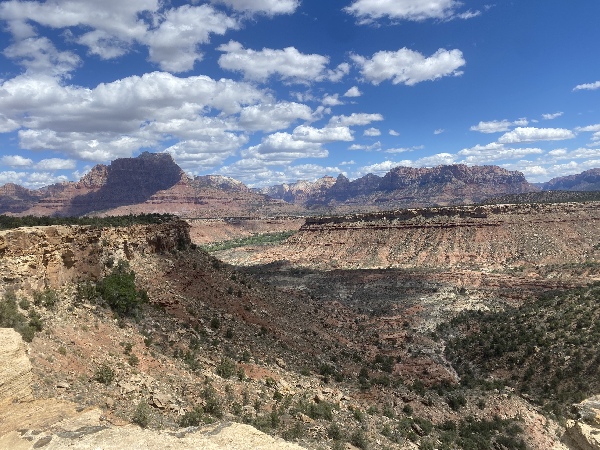
I recently ran a trail race in the hills just outside of Zion National Park. The views were gorgeous in every direction. “Is this for real?” I thought. “Am I really allowed to live in this amazingly beautiful place?”
Along the way I struck up a conversation with another guy because his shirt said that said he was running for someone with Duchenne muscular dystrophy. It was his son. I told him that I was a neurologist who had trained at a university with widely known experts in that disease. This man was familiar with some of the doctors that I spent a lot of time with when I was a neuromuscular fellow.
After the race I asked if I could meet his son, so we walked over to the parking area. The terrain was a little too rough for him to get out of the car, so he sat in the passenger seat and I talked to him through the open window. It was this young man’s first visit to Utah, and he had been to both Bryce Canyon and Zion that week. I told him about how my dad was a geologist, so I went to places like this often when I was a kid.
As we walked away this man thanked me for taking the time to visit his son. I know how much it means to people who have visible disabilities when someone talks to them like they are normal human beings.
When my kids were little, and I was still at the university learning about these rare diseases, I once quizzed them: “What should you do if you see a kid in a wheelchair?” They didn’t answer. “Should you stare at them?”
“No,” my daughter said. “You should look away.”
I shook my head. “Not that either. Here’s what you do: smile and say, ‘Hi.’”
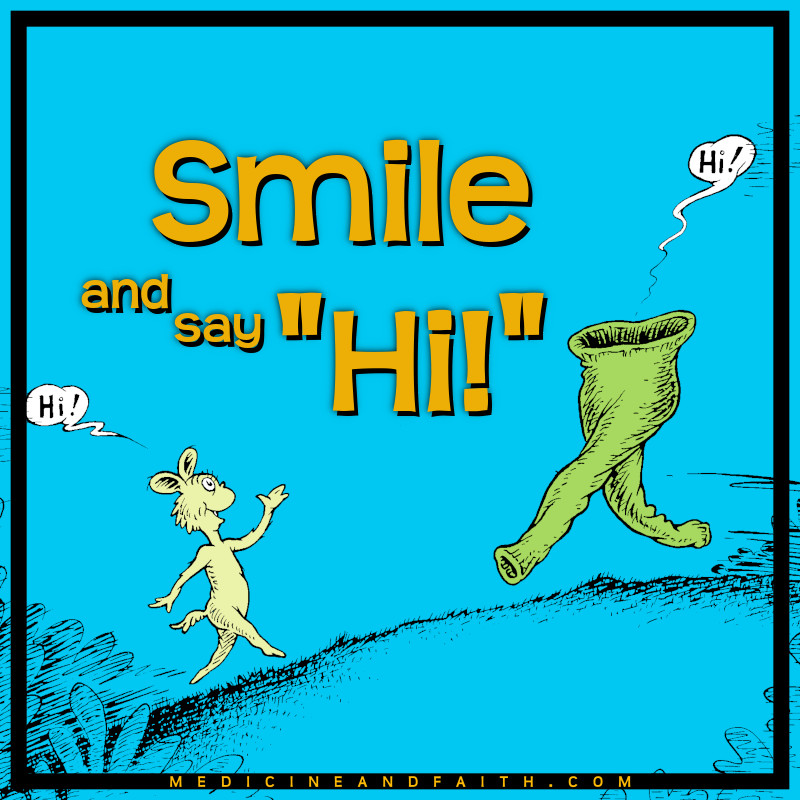
My parents often read a story by Dr. Seuss called “What Was I Scared Of?” (It was the last story in The Sneetches and Other Stories.) It is a classic horror story, and I remember the creepy, anxious feeling it gave me when my dad would read it to me when I was very young. Our copy of the book was so well-worn that the hardback cover fell off.
The protagonist in this story, who is the first person narrator, was terrified by a “pair of pale green pants with nobody inside them.” These pants could somehow walk around by themselves and do things like ride a bicycle and row a boat. Over and over again, and always at night, these pants would show up wherever the narrator happened to be, and the poor little guy was more and more frightened with every encounter.
In the climax of the story, the narrator is in a solitary place, standing face to face with the empty pants. When he screams for help the pants start crying and shaking. At this moment he realizes that the pants are just as scared as he is.
I never heard such whimpering
And I began to see
That I was just as strange to them
As they were strange to me!
The main character feels compassion for the empty pants, and tries to comfort them. As a result the two become friends. The last page of the book shows the main character and the pale green pants with nobody inside them greeting each other kindly.
And, now, we meet quite often,
Those empty pants and I,
And we never shake or tremble.
We both smile
And we say
“Hi!”
People are people first, before they belong to any other category or classification. And all people are children of God, which makes them my brothers and sisters before they are anything else.
- The boy in the wheelchair is my brother.
- The girl with dark skin, or who speaks a different language, is my sister.
- The person who has political opinions I disagree with is someone I can love.
- The soldier in the opposing army is also a child of God.
Dallin H. Oaks, who was just sustained as President of The Church of Jesus Christ of Latter-day Saints, taught this in his General Conference address this month:
Living worthy to meet Christ is no easy task. Many current writers characterize the time in which we live as toxic, a time of contempt or hostility toward adversaries. This hostility affects many different relationships in society, involving many whose Christian beliefs should orient them otherwise.
Our Savior, Jesus Christ, taught us how to relate to one another. The great commandments in the law, He taught, were to love—God and neighbor (see Matthew 22:37–39). …
Each of us can strive to follow our Savior in His teachings about how to relate to one another. This does not mean surrendering our values.
… As followers of Christ, we should seek to live peaceably and lovingly with other children of God who do not share our values and do not have the covenant obligations we have assumed.
Thinking this way is not always easy, especially in a fractious and polarized world. But the need for peacemakers is great, whether it is on the school playground, at the finish line of a race, in a silly picture book, or in the halls of government.
So the next time you see someone who is different from you, whether because of a physical disability, or because they are from another country or culture, or because they have joined a political party you disagree with, don’t be so defensive. Just smile and say “Hi!”
Alan B. Sanderson, MD is a member of The Church of Jesus Christ of Latter-day Saints and is a practicing neurologist.